1Highlights
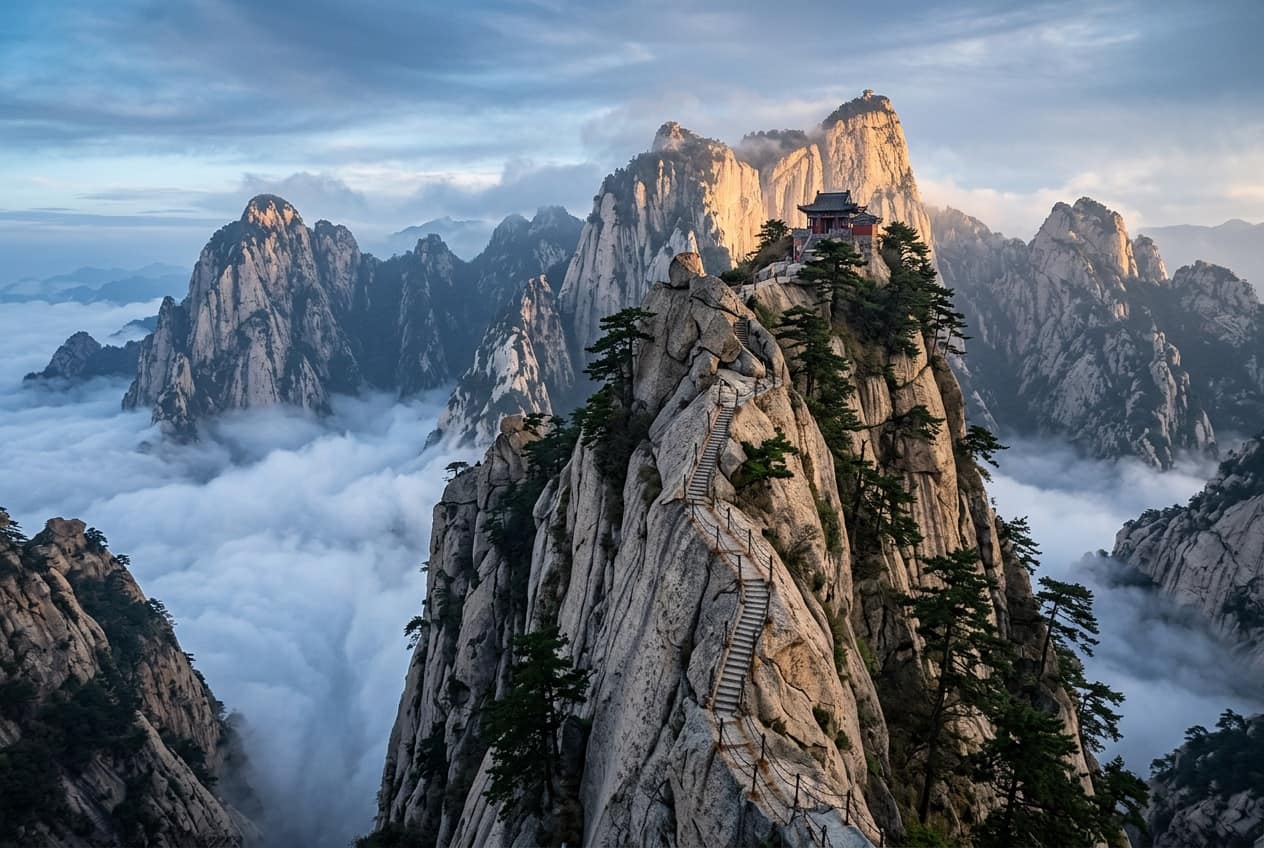
Mount Hua is a full-day mountain trip from Xi'an, not a city attraction, and it punishes loose planning in a specific way: the mountain sells two different admission tickets, and each is checked at a different entrance several kilometres apart. One is the walking ticket, validated at the Huashan Gate by the Yuquan Temple, where the historic stone staircase up the north face begins. The other is the cable-car ticket, bundled with a shuttle bus and validated at the visitor centre. Arrive at the wrong gate with the wrong ticket and you do not have a minor problem — you have a taxi ride and a lost morning. Beyond that, the geography is simple enough to hold in your head. Five peaks ring a central saddle: South is the highest at just over 2,150 m, then East, West, Centre, and North lowest at around 1,615 m. Two cable cars serve the mountain, West and North, and almost every itinerary is a choice about which one you ride up and which you ride down. The exposed features the mountain is famous for — the plank walk bolted to the south face, the Yaozi Fanshen chain descent on the east — are optional paid experiences on side spurs, not sections of the main route, and not a test anyone needs to pass.
- Highest point
- South Peak, just over 2,150 m
- From Xi'an
- High-speed rail to Huashan North, about 30 min
- Two admission types
- Walking gate or visitor centre — not interchangeable
- Cable cars
- West Peak and North Peak
- Cost structure
- Admission, shuttle and cable car stack separately
- Uphill cable-car cutoff
- Ends hours before downhill service does
- Allow
- A full day, or overnight for sunrise
- Summit temperature
- Several degrees below the valley
2Tickets
Budget by the total, not by the admission figure, because three separate purchases stack: park admission, the in-park shuttle bus, and the cable car — each priced per direction. A one-day round trip using a cable car each way typically comes to several times the headline admission price, and the headline price itself has a peak and an off-peak tier. Two details about validity catch people out. The admission ticket is for the day and for a single entry, so stepping out of the park and back in is not something to plan around. Cable-car tickets, by contrast, have been sold with a longer validity window than the admission ticket itself — useful for an overnight stay, confusing if you assume the two expire together. Students and older visitors have had discounts on admission and on the cable cars at different rates, with children banded by height. All of this changes between seasons and announcements; check the official platform for your date and buy the combination that matches the route you have chosen, not the cheapest line item.
| Walking admission | Seasonal tiers | Validated at the Huashan Gate near Yuquan Temple, where the stone staircase begins. This ticket does not admit you at the visitor centre. |
|---|---|---|
| Admission plus shuttle bus | Seasonal tiers | The ticket for any cable-car route, validated at the visitor centre. The shuttle is not optional on these routes — the cable-car base stations are not walkable from the entrance. |
| West Peak cable car | Per direction, higher tier | The long, dramatic one. Roughly the longer ride of the two and priced accordingly; pairs with a longer shuttle leg. |
| North Peak cable car | Per direction, lower tier | Shorter and cheaper, with a shorter shuttle leg. The economical way onto the mountain, but it lands you at the lowest peak. |
| Shuttle bus, each direction | Separate from the cable car | Priced separately for the West and North sides. Easy to forget when adding up a route that goes up one side and down the other. |
| Plank walk and chain descent | Paid add-on per feature | A safety-harness rental is charged at each, and you sign a waiver. Entirely optional spurs off the main route. |
The two admission tickets are not interchangeable:This is the mistake that ruins days here. The walking ticket is checked at the Huashan Gate by Yuquan Temple; the cable-car ticket, bundled with the shuttle, is checked at the visitor centre. These are different places. Decide your route first — walking up, or riding up — then buy the matching ticket, then navigate to the gate that ticket belongs to. If you are unsure which you bought, resolve it before you leave Xi'an, not at a barrier.
Uphill cable cars stop long before downhill ones:The two directions do not share a closing time. Uphill ticket checking has ended in the mid-afternoon while downhill service continued into the evening — a gap of around three hours. The consequence is specific: a late start does not merely shorten your day, it can leave you unable to get up the mountain at all, and a slow descent can leave you unable to get down. Work backwards from the uphill cutoff when planning, and treat the last downhill car as a hard deadline rather than a target.
The exposed features are optional and gated:The plank walk and the chain descent are paid spurs with harness rental and a signed waiver, and they queue — sometimes for a long time in peak season. They are also the first things closed when weather turns. Nobody needs to do them to have climbed Mount Hua, and anyone with vertigo, a heart condition, high blood pressure or simply a bad night's sleep has a good reason to walk past. If you do want one, do it early in the day while the queue is short and the rock is dry.
Buy through the official platform:The mountain runs real-name timed booking through its own official channel, with some authorised resellers. Street sellers offering a cheaper way up, a route that avoids the ticket, or a guide who knows a back path are selling you an unmanaged trail on a mountain with genuine exposure. There is no version of this that is a bargain.
Klook
Compare Mount Hua tickets, cable-car combinations and transfers
Klook may list admission, cable-car combinations and day trips from Xi'an. The things to check on the exact listing are unusually important here: which admission type is included and therefore which gate it is checked at, whether the shuttle bus and both cable-car directions are covered, which route is planned, how much time you actually get on the mountain, and the weather-cancellation terms.
- Compare the exact product inclusions and meeting point
- Check current reservation, ID, redemption and cancellation rules
- Do not treat a listing as a guarantee of entry or queue-free access
- Cross-check the attraction's official notice before paying
Disclosure: this is an affiliate link. We may earn a small commission if you buy through it, at no extra cost to you. We only recommend products we would use ourselves.
3Getting There
Getting there is the easy part, and high-speed rail has made it almost trivially simple: Xi'an to Huashan North takes about half an hour, and local transport connects the station to the visitor centre. The hard part is the return, which has to be planned against the cable car's closing time rather than the train timetable.
About thirty minutes from Xi'an, then a short local bus or taxi to the visitor centre. The fastest and most reliable option, and the one that makes a day trip comfortable rather than rushed.
Around two hours to Huayin, the town at the foot of the mountain. Cheaper than rail and considerably slower; reasonable if your schedule is loose.
Roughly an hour and a half via expressway, with paid parking at the visitor centre. Worth it only if you are continuing somewhere else afterwards.
Confirm separately which admission type is included, whether the shuttle and cable car are covered, which route is planned, and how much time you actually get on the mountain before the group turns back.
Worth knowing exists, because this is the fallback if you arrive at the wrong entrance. The walking gate and the visitor centre are not within walking distance of each other.
Check the mountain's weather channel, not a city forecast:The valley and the summit are different weather systems, and a clear forecast for Xi'an says little about whether the cable cars are running or the plank walk is open. The scenic area publishes its own weather and operating notices; read those the night before and again on the morning. Rain, snow, ice, high wind or maintenance can close the cable cars and the exposed sections outright, and no itinerary should assume a route will be open because a social-media post said so.
Bring gloves, and treat them as equipment:Long stretches of the historic staircase are climbed holding iron chains, which are cold, polished smooth by use, and genuinely slippery when wet. Cheap cotton gloves sold at the foot of the mountain solve this. Grippy shoes matter more than any other item of clothing, and a wind layer matters more than the valley temperature suggests.
4Route & Photos
Choose the route first and let it determine the ticket, not the other way round. Four combinations cover almost everyone, and they differ mainly in how much descending you do on foot — which, on a staircase mountain, is what actually hurts the next day.
West up, North down is the default worth defending:It rides the long scenic cable car on the way up, crosses the full ridge past South, East and Centre peaks, and descends the shorter cheaper cable car from the lowest peak — so you cover every major summit, never retrace a step, and spend most of the walking day going downhill. West up, West down is the shorter and gentler version for families or anyone with limited stamina, at the cost of skipping the North Peak side. North up, West down is the same loop in reverse and is the harder, more rewarding direction because it climbs the exposed Canglong Ridge; many visitors choose it for exactly that reason.
Recommended Route
- 1
Decide the route, then buy the matching ticket
Walking up means the Huashan Gate ticket and the Yuquan Temple entrance. Riding up means the admission-plus-shuttle ticket and the visitor centre. Get this order right and most of the mountain's logistics solve themselves.
- 2
Start early enough to clear the uphill cutoff
The uphill cable car stops checking tickets in the afternoon, hours before downhill service ends. A morning start is not a preference here, it is the thing that makes the rest of the plan possible.
- 3
Ride the West Peak cable car up
The long ascent along the cliff faces, and the best single view you will get without walking for it. The shuttle leg to the base station is longer on this side — build it into the schedule.
- 4
West Peak, then South Peak
West Peak has the split-rock formation and the broad terrace; South Peak, a walk further along the ridge, is the mountain's highest point and the access point for the plank walk spur. Decide about the plank walk here, based on the queue and the weather, not on what you told yourself at home.
- 5
East Peak and the ridge
East Peak is the sunrise viewpoint and the top of the Yaozi Fanshen chain descent. If you are staying overnight, this is where you want to be in the morning; if not, it is the natural turning point of a day traverse.
- 6
Centre Peak, Jinsuo Pass, then North Peak
The descending traverse through the central saddle. Jinsuo Pass is where the ridge routes converge, and the stretch down to North Peak passes the Canglong Ridge section — which is far more comfortable descended than climbed.
- 7
North Peak cable car down, with margin
Reach the North Peak station with real time to spare rather than cutting it fine. Then the shuttle back to the visitor centre, and the train. The last cable car down is the one deadline on this mountain with no workaround.
Best Photo Spots
The West Peak cable-car ascent
Shoot through the window on the way up, early, before the cabin glass hazes and while the light is still coming in low across the faces. A fast shutter beats a careful composition here.
The split rock at West Peak
The formation the legend is attached to, and the most recognisable object on the mountain. Include a person for scale; without one the photograph reads as an ordinary boulder.
South Peak summit marker
The highest point, and the one summit photograph worth queuing for. Go while the cloud is moving — a clear flat sky is less interesting here than cloud breaking over the ridge.
East Peak at sunrise
Only available if you stay overnight, and the reason people do. Arrive at the viewing terrace well before the published sunrise time, bring a wind layer, and accept that cloud decides whether this works.
Canglong Ridge from above
The knife-edge staircase with drops on both sides, best photographed looking back down it from the upper end. This is the image that explains the mountain's reputation better than any peak marker.
5Food & Stay
| Summit hotel restaurantsSimple hot meals | Varies | Everything on the summits arrives by cable car or on someone's back, and prices reflect that. Reasonable for a hot bowl of noodles; not the place to plan a proper meal. |
|---|---|---|
| Carry your own food and waterTrail supplies | Varies | The practical approach: high-calorie snacks and more water than you think, bought in the valley. Bottled water on the summits costs several times the valley price for obvious reasons. |
| Huayin town, after the descentLocal Shaanxi food | Varies | Where the actual meal belongs. Dadao mian, the broad hand-cut noodles, and Huashan liangfen are the local dishes worth finding before the train back. |
Eat before you climb, not during:A heavy meal before a staircase is worse than no meal, and stopping for a long lunch mid-traverse costs you margin against the cable-car deadline. The pattern that works is a real breakfast in the valley, snacks and water on the mountain, and a proper meal in Huayin afterwards.
Where to Stay
- Staying on the summit is the only way to see sunrise from East Peak, and it changes the trip completely. The hotels are basic — dormitory beds, limited washing facilities, thin walls — and they book out well ahead in peak season. East Peak is closest to the sunrise terrace; West Peak suits sunset better.
- Staying at the foot of the mountain, near Yuquan Temple or in Huayin, is the sensible middle option: proper rooms at ordinary prices, and you are at the gate when it opens. This is also the base for a night ascent, since the walking route is open around the clock.
- Staying in Xi'an and doing Mount Hua as a day trip works, given the half-hour train — but only with an early start. The uphill cable-car cutoff, not the last train, is what makes a late departure from Xi'an unworkable.
6Tips & Pitfalls
- Prices, opening hours, transport schedules and reservation rules can change; verify the official notice for your date.
- Keep your passport or the original ID used for a booking available; a screenshot may not be accepted.
- Match the ticket to the gate before you travel. Walking ticket goes to the Huashan Gate at Yuquan Temple; admission-plus-shuttle goes to the visitor centre. They are kilometres apart and not interchangeable.
- Gloves and grippy shoes are equipment, not comfort items. The staircase sections are climbed on iron chains polished smooth by millions of hands, and they are slick when damp.
- Check the scenic area's own weather and operating notices the night before and again in the morning. A clear forecast for Xi'an tells you almost nothing about cable-car operation or whether the exposed spurs are open.
- Plan the whole day backwards from the last downhill cable car. On a staircase mountain, descending on foot in the dark because you missed it is a different and much worse trip than the one you planned.
- The plank walk and the chain descent queue, cost extra, require a signed waiver, and close first in bad weather. Skipping them is a perfectly complete visit to Mount Hua.
- Walk looking at your feet and stop to look at the view. The old local advice — do not sightsee while walking, do not walk while sightseeing — exists because the drops here are real and the steps are uneven.
- Travel light. There is no luggage storage logic that makes carrying a suitcase up a mountain work; leave bags in Xi'an or at a hotel in Huayin.
- Be sceptical of anyone selling a cheaper way up or a route that avoids the ticket. Those are unmanaged paths on a mountain with genuine exposure, and the saving is not worth the category of risk involved.
7Frequently Asked Questions
Which Mount Hua ticket do I need?
It depends entirely on whether you walk up or ride up, and the two are checked at different entrances. The walking ticket is validated at the Huashan Gate near Yuquan Temple, where the historic staircase starts. The cable-car route requires the admission-plus-shuttle ticket, validated at the visitor centre, because the cable-car base stations are not reachable on foot from the entrance. These gates are kilometres apart, so decide the route first and buy accordingly.
West Peak or North Peak cable car?
West Peak is the longer, more spectacular and more expensive ride, with a longer shuttle leg; North Peak is shorter, cheaper and lands you at the lowest summit. The usual answer is both: ride West up and North down, which covers every major peak, never retraces a step and leaves you walking downhill most of the day. If stamina or time is limited, West up and West down is shorter and gentler but skips the North Peak side.
How much does Mount Hua cost in total?
More than the admission figure suggests, because three things stack: park admission, the shuttle bus and the cable car, each priced per direction, with peak and off-peak tiers on top. A one-day round trip riding a cable car each way typically comes to several times the headline admission price. Add the harness rental if you do the plank walk. Prices and tiers change, so build the total from the official platform for your date rather than from any guide.
Is the plank walk dangerous, and do I have to do it?
You do not have to do it — it is an optional paid spur off the main ridge, not part of any route. It is a narrow boarded ledge bolted to a cliff face, done wearing a rented harness after signing a waiver, and it queues. The managed risk is low, but the exposure is total and it is genuinely unsuitable for anyone with vertigo, a heart condition or high blood pressure. It also closes first in rain, snow or wind. Plenty of people climb Mount Hua without going near it.
How do I get to Mount Hua from Xi'an?
High-speed rail is the clear winner: Xi'an to Huashan North takes around half an hour, and a short local bus or taxi connects the station to the visitor centre. Coaches to Huayin take about two hours and cost less; self-driving is roughly an hour and a half. Whichever you choose, the binding constraint on a day trip is not the outbound journey but the uphill cable-car cutoff in the afternoon.
Can I climb Mount Hua in one day from Xi'an?
Yes, and many people do. A cable-car route such as West up and North down fits comfortably into a day given the half-hour train, provided you start early. What does not fit is a late start: the uphill cable car stops checking tickets hours before downhill service ends, so an afternoon departure from Xi'an can leave you unable to get up at all. If sunrise from East Peak is the goal, that requires staying on the summit.
Is it worth staying overnight on the mountain?
If sunrise from East Peak matters to you, yes — it is the only way to get it, and it turns a hard day into two easier halves. Be clear about the trade: summit accommodation is basic, with dormitory beds, limited washing facilities and thin walls, and it books out well ahead in peak season. East Peak is closest to the sunrise terrace. If sunrise is not a priority, a day trip with an early start is the better-value plan.
What should I bring to Mount Hua?
Grippy shoes above everything else, and gloves — the staircase sections are climbed holding iron chains that are cold and slippery when damp, and cheap cotton gloves at the foot of the mountain solve it. Add a wind layer because the summits run several degrees below the valley, water and high-calorie snacks bought before you ascend, and your ID for entry. Leave the suitcase in Xi'an; carrying luggage up a staircase mountain is its own punishment.
Combine With
Other Xi'an sights that genuinely pair well with this one
Before You Go
The practical guides you will actually need here
All Xi'an attractions
Yesim
Keep the weather and operating notices reachable on the mountain
Cable-car suspensions, closures of the exposed spurs and changes to operating hours are published online and can change during the day you are there. Being able to check them from the ridge — and to re-open your booking at a gate — is the practical reason to sort mobile data before you leave the city.
- Check China coverage and whether the plan needs a local app to activate
- Confirm your phone supports eSIM and is carrier-unlocked before buying
- Activate and test the data connection before you leave the city
- Treat an eSIM as data access, not as a substitute for any reservation
Disclosure: this is an affiliate link. We may earn a small commission if you buy through it, at no extra cost to you. We only recommend products we would use ourselves.
GoChinaTravel Editorial Team
Our team of China travel researchers combines on-the-ground contributor insights, official government sources, and traveler community feedback to create the most detailed English-language China guides available. Every guide is fact-checked against primary sources (NIA, 12367, official attraction websites, Railway 12306) before publication.