1Highlights
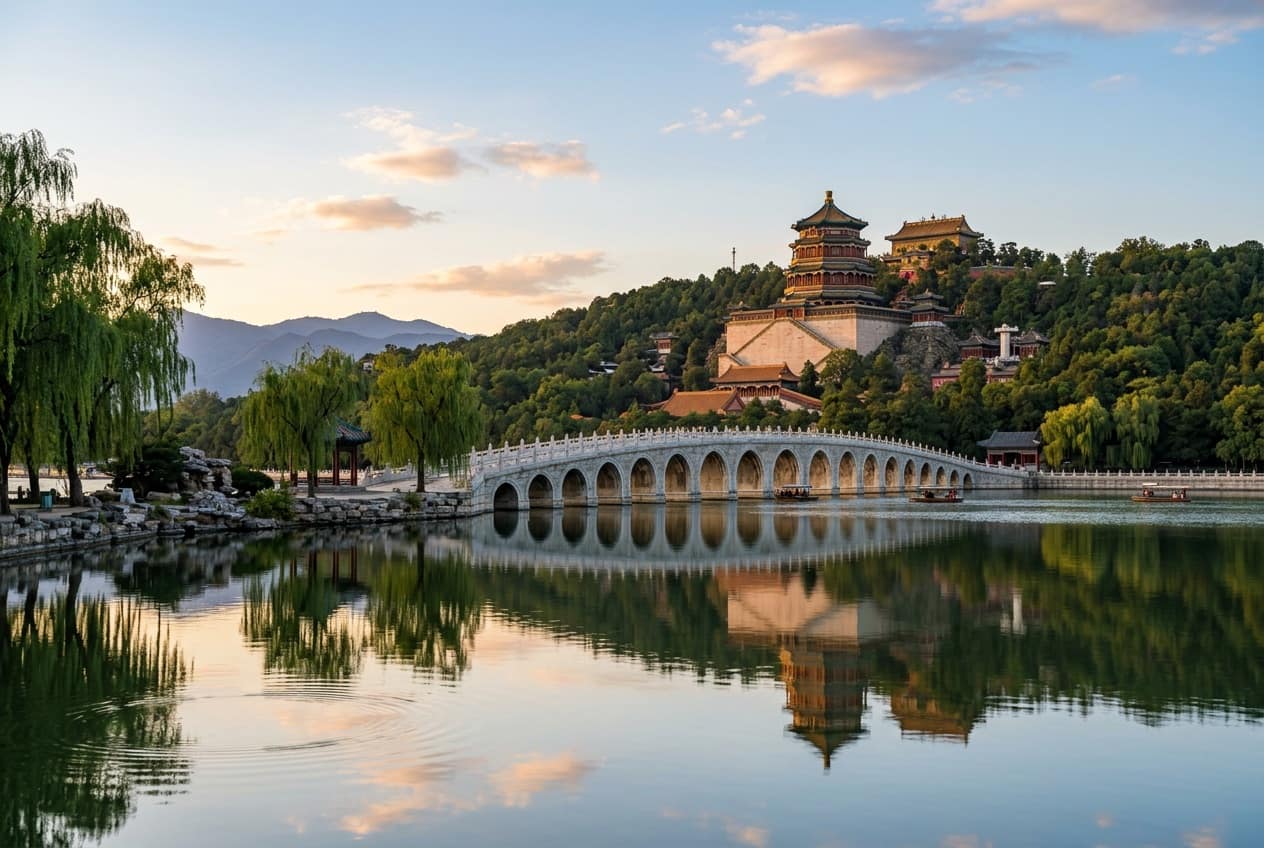
The Summer Palace is China's largest and best-preserved imperial garden — roughly 300 hectares of which about three-quarters is water. Qianlong built it, Cixi rebuilt it after it was burned, and the difference from the Forbidden City is the point: this is a palace designed for living in rather than for ceremony, which is why it reads as landscape with buildings in it rather than the other way round. Two practical facts shape a visit far more than any of that history. First, the park and the ticketed courtyards inside it keep different hours — the gates open around dawn, but the Buddha Incense Pavilion, Dehe Garden, Suzhou Street and the museum open roughly two hours later and stop admitting well before the park closes. Second, there are five entrances spread around a site you cannot walk a loop of, and which one you choose determines whether you start in the court buildings, at the foot of a hill climb, or standing on the lake shore looking at the Seventeen-Arch Bridge.
- Built
- 1750, rebuilt 1886
- Area
- ~300 ha
- Water
- About 3/4
- Entrances
- Five
- Two clocks
- Park vs courtyards
- Mondays
- Courtyards closed
- Allow
- 3–5 hrs
- UNESCO
- 1998
2Tickets
Three tiers: a gate ticket for the park, a combination ticket that adds the four main inner gardens, and individual tickets for those gardens bought one at a time. The four priced separately come to more than the combination, so if you intend to go inside anything at all the combination is the cheaper instrument — with one condition attached, explained below. Everything is online and real-name; there is no staffed ticket window on site. Peak and off-peak rates differ and the park publishes the current figures, so confirm rather than budgeting from a guide.
| Gate ticket (peak) | ¥30 | Park only — the lake, the Long Corridor, the Marble Boat, the bridge. Off-peak is lower |
|---|---|---|
| Combination ticket (peak) | ¥60 | Gate plus the four main inner gardens. Cheaper than buying those four separately |
| Combination ticket (off-peak) | ¥50 | Same coverage at the winter rate. Check the current season boundary dates |
| Buddha Incense Pavilion alone | ¥10 | The hill summit and the best view over Kunming Lake. Steep steps, no ramp |
| Other inner gardens, individually | ¥5–20 each | Dehe Garden, Suzhou Street and the park museum are each sold separately — add them up before deciding against the combo |
| Boats | Per leg | Scheduled ferries across the lake are priced per leg; self-drive electric boats are hourly with a deposit. Seasonal — see below |
The park and the courtyards run on different clocks:This is the mistake that wastes a combination ticket. The gates open around dawn — a famously good time to have the lake almost to yourself — but the Buddha Incense Pavilion, Dehe Garden, Suzhou Street and the museum open roughly two hours after the park does, and stop admitting visitors well before the park closes. The small specialist courtyards keep the same later hours. So arriving at opening and using your combo are two different plans: arrive early for the empty lakeside, then be at the first courtyard when it opens, rather than standing outside a locked gate you have already paid for.
Mondays close the inner gardens:Outside public holidays, the ticketed courtyards close on Mondays while the park itself stays open. A combination ticket on a Monday buys you nothing you would not get with the gate ticket. The park is still a fine Monday walk — the lake, the Long Corridor, the Marble Boat and the bridge are all in the open park — but buy accordingly.
Online only, and the booking is a window:The park runs all-online real-name booking with no staffed ticket window on site, one ticket per document, and a published advance window of several days. The booked ticket admits you during its stated period and lapsed bookings are void, non-transferable and non-refundable — a stricter rule than the Great Wall sections north of the city. Entry is a document scan: carry the original passport or permit you booked with, not a photograph of it.
Free admission here does not need a booking:Unusually, the park states that visitors who qualify for free entry do not need to reserve — they are verified against their document at the gate — and that the free entry covers both the gate and the inner gardens, not just the park. The eligible categories explicitly include non-residents and foreign nationals verified by passport, and the published age threshold for older visitors has been revised, with older guides still quoting the previous one. Check the current notice: if someone in your group qualifies, it changes what the rest of you should buy.
Half-price categories:Students up to and including undergraduate level, minors above the free-entry age, and holders of certain social-benefit certificates are sold half-price tickets against the relevant document. Student concessions generally exclude postgraduate and adult-education enrolment. Bring the card, not a screenshot of it.
Klook
Book tours, tickets and activities in China
Klook lists tickets, tours and activities for many major attractions in China with an English-language booking flow. Product inclusions, available payment methods, reservation steps, ID requirements, voucher redemption and cancellation terms vary by listing and attraction, so check the product page and the attraction's official rules before paying.
- English-language listings for attraction tickets, guided tours and day trips
- Available payment methods are shown on the individual checkout page
- Reservation and real-name ID details vary by attraction and product
- Voucher format and on-site redemption instructions are product-specific
- Read the cancellation policy and official attraction notices before booking
Disclosure: this is an affiliate link. We may earn a small commission if you buy through it, at no extra cost to you. We only recommend products we would use ourselves.
3Getting There
Metro reaches three of the five gates directly, which is the easiest way to control where your visit starts and ends. The park is not a loop, so plan to enter at one gate and leave by another.
Metro Line 4 or 16 to Xiyuan, then a short walk. Starts you in the court section: the audience hall, the imperial living quarters, then the Long Corridor. Flat, and the most logical first visit
Metro Line 4 to Beigongmen, which exits almost at the gate. Puts Suzhou Street immediately inside and then sends you up and over Longevity Hill — the quickest route to the Buddha Pavilion, and the hardest on knees
The suburban tram line terminates here. Opens onto the western dyke and its bridges, the emptiest part of the park, but leaves you a long walk from the hill and the court buildings
Easiest by taxi or ride-hailing. Drops you closest to the Seventeen-Arch Bridge and South Lake Island — the right choice if the bridge at sunset is your main objective, or as an exit after walking down from the hill
The gate you pick is the biggest decision you make:The site stretches for kilometres along a lake with a hill at one end, and there is no sensible circular route — walking back to where you started costs an hour you did not plan for. In practice: enter at the East Gate for the court buildings first and flat ground throughout; enter at the North Gate if you want the hill and the Buddha Pavilion early and are prepared to climb immediately; enter at Xinjian Gate if the bridge and the lake are what you came for. Then leave by a different gate. A common and efficient pairing is North in and East or Xinjian out, which crosses the hill once and never doubles back.
Accessibility: the lake half works, the hill does not:The Long Corridor and the lakeside paths are flat and wheelchair-accessible, and wheelchairs can be rented at the gates against a deposit, in limited numbers. Longevity Hill and the Buddha Incense Pavilion are steep steps with no ramp and no lift — there is no accessible route to the summit. This matters less than it sounds: the corridor, the Marble Boat, the lake shore and the bridge are a complete visit on their own, and they are the flat half.
Driving and parking:All five gates have car parks charging by the hour, with rates differing slightly between them, and none permit overnight parking. Spaces are genuinely tight at weekends and on holidays, and the surrounding roads congest badly — the metro is the better instrument on any busy day.
4Route & Photos
About five kilometres end to end, three to five hours depending on whether you climb. The structure is linear: court buildings at the east end, the hill and the Long Corridor in the middle, the lake and the bridge to the south. Choose a direction and commit to it.
Boats are seasonal and wind-sensitive:Scheduled boats run roughly mid-March to mid-November — Kunming Lake freezes in winter. Within the season, ticket sales stop in mid-afternoon and the last sailing is earlier than the park's closing, so a boat is something you plan into the middle of the day, not the end. Service is suspended when wind reaches around Force 4 and in bad weather, and this open lake catches wind hard, so a breezy forecast is a real risk. Self-drive electric boats are hourly with a sizeable deposit; chartered boats need advance notice and are not available on public holidays.
The climb is optional:Longevity Hill is the one demanding section and the only one with no accessible alternative. Skipping it still leaves you the world's longest painted corridor, the Marble Boat, the lake shore and the Seventeen-Arch Bridge — which is a complete three-hour visit. Decide at the bottom rather than halfway up, because coming back down is harder than going up on worn stone steps.
Recommended Route
- 1
East Gate → Hall of Benevolent Longevity
The front gate opens into the political core, where the court actually conducted business when it moved out here for the summer. Flat, formal, and a useful reminder that this was a working seat of government and not only a pleasure garden
- 2
The imperial living quarters
Yulan Hall, Yiyun Hall and Lehshou Hall — where Cixi actually lived, and where the Guangxu Emperor was effectively confined. These rooms are the strongest argument that the Summer Palace was built for occupation: they are domestic in scale in a way nothing in the Forbidden City is
- 3
The Long Corridor
728 metres and 273 bays along the lake, the longest painted gallery in the world — every beam carries a scene, and no two are the same. It is also the park's best wet-weather asset, being covered for its entire length, and the flattest approach to the hill
- 4
Cloud-Dispelling Hall → Buddha Incense Pavilion
The climb up the central axis to the 41-metre octagonal pavilion that is the park's high point and its emblem. The view from the upper platform — lake, bridge, Western Hills stacked behind — is the second most reproduced image of Beijing after the Forbidden City. Steep steps, no accessible route, and it keeps the later courtyard hours
- 5
Marble Boat → the lake
Down to the western end of the corridor and the marble pleasure boat that cannot sink because it cannot sail. From here either take a scheduled ferry across to South Lake Island or walk the east shore south — the walk is longer but passes the bronze ox and the open lawns
- 6
Seventeen-Arch Bridge → Xinjian Gate
The bridge out to South Lake Island is the park's other signature structure, and around the winter solstice the setting sun lines up to pierce all seventeen arches in a single run of gold — a photographic event serious enough that people arrive hours early for it. Exit at Xinjian Gate without doubling back
Best Photo Spots
The pavilion platform, looking south
The whole park in one frame: lake, Seventeen-Arch Bridge, the western dyke and the hills behind it. Morning light is cleaner; afternoon haze over Beijing often flattens the far ridges
Seventeen-Arch Bridge at the solstice
Late December, from the east shore, in the hour before sunset. Expect a wall of tripods and a specific crowd — this is a known annual event rather than a secret, and the window is only a few days wide
The western dyke
Six bridges along a willow-planted causeway modelled on Hangzhou's West Lake, with the hill and pavilion across the water. Spring blossom and bare winter willows both work, and there are a fraction of the people here
The corridor's painted beams
Shoot along the corridor rather than at a single beam — the repetition of 273 bays receding into the distance is the subject, and it is one of the few interior-feeling shots available in an outdoor park
5Food & Stay
| TingliguanImperial-style cuisine | Higher | A converted theatre inside the park. The setting is the product; book ahead, and treat the bill as paying for the room |
|---|---|---|
| Outside the East GateBeijing restaurants | Mid-range | The densest cluster of real restaurants at any of the gates, including well-known roast duck houses. This is where to plan the actual meal |
| In-park kiosksSnacks and drinks | Site pricing | Thin on the ground for a park this size, and concentrated near the corridor. Carry water, especially if you are climbing |
Plan the meal around the gate, not the park:Catering inside is sparse relative to the distances involved, and the gates differ sharply: the East Gate side has a proper restaurant district, while the West Gate side has very little. If you are exiting west or late, eat before you go in or carry something — a five-kilometre walk on two bottles of water and a corn on the cob is a specific kind of miserable.
Where to Stay
- The Summer Palace is in the north-west of the city, not the centre — which is the single most useful thing to know when slotting it into an itinerary. Staying around Haidian or Zhongguancun puts you a few Line 4 stops from two of the gates and makes an opening-time arrival realistic.
- If you are staying centrally, treat this as a half-day with a real commute attached rather than something to tack onto a Forbidden City morning. Pairing the two in one day means two major sites, a cross-city journey and a lot of walking, and the second one always suffers.
- Hotels near the Xiyuan and Beigongmen stations are the practical choice if the solstice bridge or an empty dawn lakeside is the reason you came — both require being at a gate before the city is awake, and neither survives a cross-town taxi at rush hour.
6Tips & Pitfalls
- 🚪 Decide your entry and exit gates before you leave the hotel. The park is linear and five gates lead to five different days. North in, East or Xinjian out crosses the hill once without backtracking.
- 🕗 Two clocks, one plan. Arrive at the park gate early for the empty lakeside, then time your first ticketed courtyard for when the courtyards open — about two hours after the park does.
- 📅 Not on a Monday if you want the pavilion. The ticketed courtyards close Mondays outside public holidays; buy the gate ticket rather than the combination on those days.
- 🛶 Check the wind, not just the rain. Boats stop at around Force 4 on this open lake, and a cancelled crossing turns a planned shortcut into an extra two kilometres on foot.
- ♿ The flat half is a complete visit. Corridor, Marble Boat, lake shore and bridge need no stairs. Wheelchairs rent at the gates on a deposit, in limited numbers — arrive early if you need one.
- 🆔 Carry the original document you booked with. There is no staffed ticket window and entry is a document scan; a lapsed time window makes the booking void rather than merely late.
- 👟 Five kilometres, worn stone, and shade only under the corridor. Comfortable shoes matter more here than at any walled site in Beijing, because the distances are garden distances rather than courtyard distances.
7Frequently Asked Questions
Is the Summer Palace combination ticket worth buying?
If you intend to go inside anything, yes — the four main inner gardens bought separately come to more than the combination, so it pays for itself on the second one. Two conditions, though: the courtyards close on Mondays outside public holidays, and they open about two hours after the park and stop admitting well before it closes. On a Monday, or for a dawn-only visit, buy the gate ticket instead.
Which gate should I enter the Summer Palace from?
East Gate for a first visit — it is the front entrance, starts you in the court buildings and keeps you on flat ground. North Gate if the Buddha Incense Pavilion is the priority, since it puts you at the foot of the hill immediately, though that means climbing straight away. Xinjian Gate if the Seventeen-Arch Bridge is the main objective. The park is not a loop, so pair your entry with a different exit — North in and East or Xinjian out is the most efficient combination.
Do I need to book Summer Palace tickets in advance?
Yes. Booking is all-online and real-name with no staffed ticket window on site, one ticket per document, and the ticket admits you only during its stated window — a lapsed booking is void and non-transferable. Carry the original passport or permit you booked with. Visitors who qualify for free admission are the exception: the park states they do not need a reservation and are verified at the gate.
When do the Kunming Lake boats run?
Roughly mid-March to mid-November — the lake freezes in winter. Within the season, ticket sales close in mid-afternoon and the last sailing is earlier than the park's closing time, so treat a boat as a midday item. Sailings are suspended at around Force 4 wind and in bad weather, and this is an exposed lake that catches wind hard.
Is the Summer Palace wheelchair accessible?
The lake half is: the Long Corridor and the lakeside paths are flat and accessible, and wheelchairs can be rented at the gates against a deposit in limited numbers. Longevity Hill and the Buddha Incense Pavilion are steep steps with no ramp or lift, so there is no accessible route to the summit. Staying at lake level still gives the corridor, the Marble Boat, the shore and the bridge — a complete visit.
How long does the Summer Palace take?
Three to five hours for the roughly five-kilometre route, depending on whether you climb Longevity Hill and how long you spend in the courtyards. Add the commute: the park is in the north-west of the city, so from a central hotel this is a half-day block rather than a two-hour stop, and it does not combine comfortably with the Forbidden City on the same day.
What is the Seventeen-Arch Bridge golden light?
For a few days around the winter solstice, the setting sun drops to an angle where it shines straight through all seventeen arches of the bridge at once, lighting the inner walls gold. It is a genuine alignment rather than a marketing claim, it is extremely well known among Chinese photographers, and the viewing spot on the east shore fills up hours ahead. Clear western sky is required, so a hazy afternoon cancels it.
Can older or foreign visitors get in free?
The park publishes free-admission categories that explicitly include non-residents and foreign nationals verified against a passport, and the free entry covers both the gate and the inner gardens rather than just the park. The age threshold for older visitors has been revised and older guides still quote the previous figure, so check the current notice. Where free entry applies, no reservation is needed — verification happens at the gate.
Combine With
Other Beijing sights that genuinely pair well with this one
Before You Go
The practical guides you will actually need here
Sort Your Visa First
All Beijing attractions
Airalo
The world's most popular travel eSIM
Airalo is the largest travel eSIM marketplace by users, with China plans from multiple carriers. Prices are competitive and the app is well-designed. Like other travel eSIMs, data routes through an overseas gateway so blocked sites are accessible without a VPN. A solid backup if Yesim or Saily do not have the plan length you need.
- Largest selection of China eSIM plans from multiple carriers
- Competitive pricing, especially for shorter trips
- Overseas gateway — blocked sites work without VPN
- Well-designed app, easy QR code installation
Disclosure: this is an affiliate link. We may earn a small commission if you buy through it, at no extra cost to you. We only recommend products we would use ourselves.
GoChinaTravel Editorial Team
Our team of China travel researchers combines on-the-ground contributor insights, official government sources, and traveler community feedback to create the most detailed English-language China guides available. Every guide is fact-checked against primary sources (NIA, 12367, official attraction websites, Railway 12306) before publication.