1Highlights
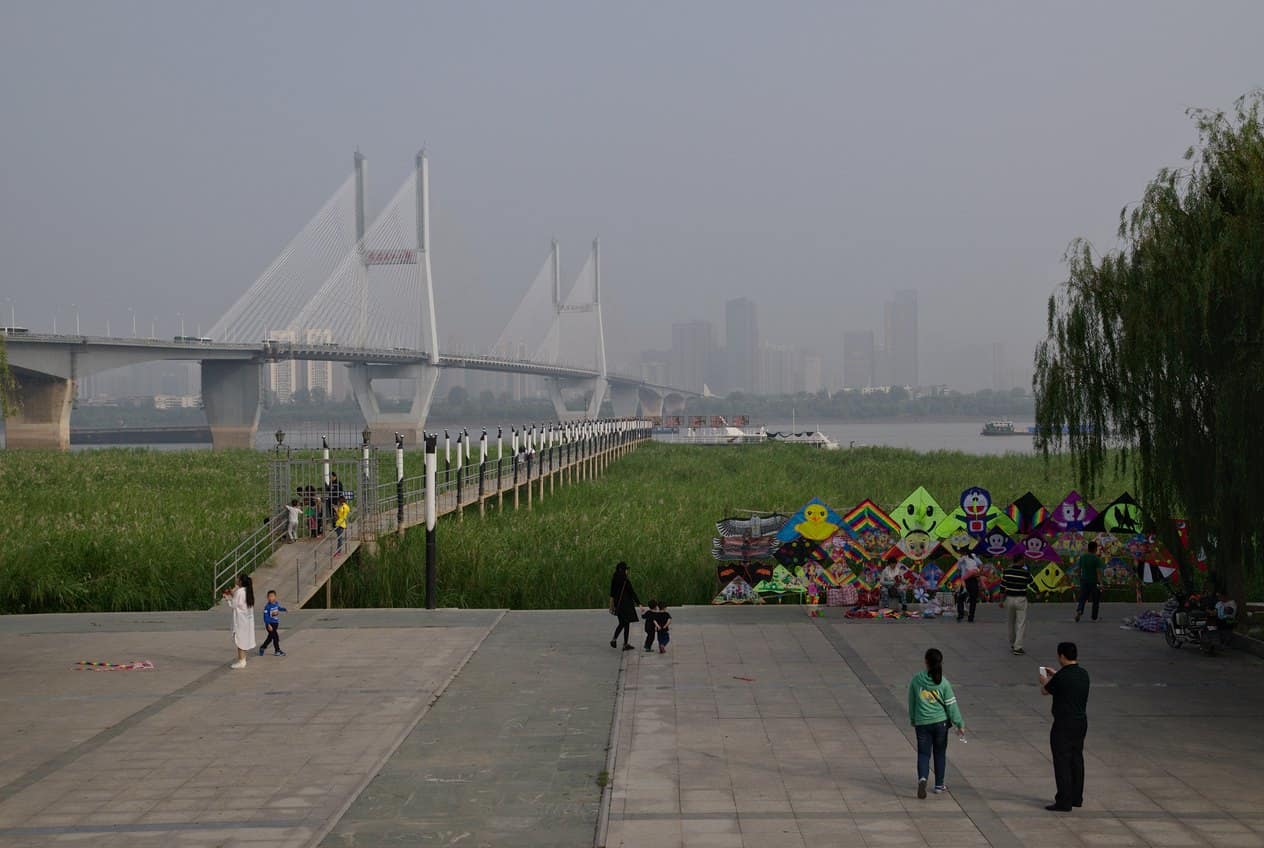
Choose the bank before you choose the walk. The Hankou Riverfront runs along Yanjiang Avenue on the north-west bank of the Yangtze; Wuchang is across the water and Hanyang is a different area again, and all three have riverfront parks. What makes the Hankou one the first choice for most visitors is that it sits directly below old Hankou: you can walk out of the concession-era streets, cross one road, and be on the water. For a first visit the section between the Customs House and the Flood Control Monument is the one to walk. It is free, open, and gives you the river traffic, the Wuchang skyline opposite, and a clear sense of why this bank was built where it was. The monument at the end is a reminder of what the river does when it rises — flood management is the reason the promenade exists in its current form. The autumn reeds that appear in photographs are a different outing: they grow near the Second Yangtze Bridge, further along, and are best treated as a separate trip rather than an extension of this walk.
- Which bank
- Hankou, the north-west bank — not Wuchang or Hanyang
- Cost
- Public paths and green space are free
- Hours
- Not a blanket 24 hours — gates follow seasonal signs
- First-visit section
- Customs House to the Flood Control Monument
- Time needed
- Two to three hours for one section
- Reeds
- Autumn, near the Second Yangtze Bridge — a separate outing
- Ferry
- Commuter crossing, a couple of yuan
- Nearest metro
- Jianghan Road — then a walk on public pavements
2Tickets
Public access to the riverfront is free; the businesses along it are not. Walking in an open public area requires no cruise ticket, and no boat purchase gives you anything the pavement does not. What costs money is each separate operation: boats, performances, meals and parking. Two caveats matter more than the money. First, free does not mean open around the clock — gate and boardwalk hours follow seasonal arrangements and temporary notices, and flood conditions, severe weather or major events can bring closures, capacity controls or free identity-based reservations for particular zones. Second, a commuter ferry and a commercial sightseeing cruise are not the same product: they use different piers, different routes and different tickets, and a fare quoted for one tells you nothing about the other.
| Public park areas | Free | Walk only in areas and during hours that are currently open, and follow local restrictions. There is no blanket 24-hour claim here |
|---|---|---|
| Major-event entry | Free, but may need booking | Past large events have used free identity-based, zoned reservations with gate controls. That is an event measure, not a daily requirement — check the current notice |
| Commuter ferry | A couple of yuan | River transport between the Hankou and Wuchang banks. Confirm today's boarding points — the operator distinguishes commuter piers from sightseeing ones |
| Sightseeing cruise | Product-specific | Not interchangeable with a commuter ticket, and not necessarily departing from the same pier. Verify the vessel, pier number and check-in deadline for your booking |
| Exhibitions and extras | Per operation | The exhibition hall beneath the Flood Control Monument, meals, parking and shows each follow their own arrangements and are not included in free park access |
A commuter ferry is not a cruise:The operator runs both, and they are different services. The commuter crossing is public transport between named piers on the two banks, costs a couple of yuan, and is a genuinely good way to see both skylines for almost nothing. A sightseeing loop or evening cruise is a commercial product with its own route, its own terminal and its own price. Tickets are not interchangeable and boarding from the same pier is not guaranteed. Before adding a boat to the day, confirm today's sailing, the terminal, the ticket category and how you get back.
Lighting programmes are not a nightly guarantee:The two-rivers-four-banks lighting that appears in photographs follows current programmes and themed events, and a report describing one evening's display is not a promise of the same show on yours. Nor is complete visibility from every section. Enjoy whatever is operating, but do not stand in cold river wind waiting for a performance you have not confirmed — and plan your return around the metro's last train rather than around the lights going off.
3Getting There
Use Jianghan Road as the street-side starting point: the metro station connects Lines 2 and 6, and from there it is a walk on public pavements to the water. The crucial distinction at this end is that Jianghan Customs House, Wuhan Guan ferry terminal and the named park gates are three different things — the first is a landmark building, the second is transport infrastructure, and the third is how you get into the park. Read the Chinese sign on whichever gate you reach.
Lines 2 and 6. The street-side starting point for this walk — the park still needs a walk on public pavements after you exit
Line 2 to Jianghan Road, then walk. Check that your rail ticket says Hankou rather than Wuhan, and allow separately for security and leaving the station
Both need a metro transfer to Line 2 and a river crossing. These are identifiable routes rather than fastest-route promises — follow current platform signs
A couple of yuan between the two banks, and the cheapest way to see both skylines. Confirm today's operation, boarding point and the return before relying on it
Wuhan, Wuchang and Hankou are three different railway stations:They are in three different districts, tens of kilometres apart, and "Wuhan Station" is not shorthand for "Wuchang Station" — it is the newest and the furthest out, in eastern Wuchang. Hankou Station sits on the north-west bank and is the closest to Jianghan Road and the riverfront. Match the Chinese name printed on your ticket before arranging any onward transport. The same logic applies to the city itself: the Yangtze separates Wuchang from Hankou, so grouping your days by bank saves far more time than optimising a route within one day.
The Customs House, the ferry pier and the park gate are three places:Jianghan Customs House is the clock-tower landmark near Jianghan Road, and it also houses a museum with its own arrangements. Wuhan Guan is a Yangtze ferry terminal — transport infrastructure, not a park entrance, and you do not need to join its boarding queue to reach the public path. A park gate has its own name and its own access notice. These are not interchangeable destinations, and a taxi instruction that names the wrong one leaves you on the wrong side of a fence. Walk from Jianghan Road through the streets to see the Customs House exterior, then follow Yanjiang Avenue to an open pedestrian gate.
4Route & Photos
Allow two to three hours for one manageable section. Start around Jianghan Road and the Customs House exterior, follow the Yanjiang Avenue pavements to a pedestrian gate that is currently open, then walk towards the Flood Control Monument and either turn back or leave from there. The exhibition hall beneath the monument has separate opening arrangements and is optional — a closed exhibition does not spoil an outdoor walk.
Recommended Route
- 1
Start at Jianghan Road
Buy water and use a restroom before you set off, then follow the pavements towards the Customs House. Keep any shopping optional and count it separately from the riverside walk — the two use time quite differently.
- 2
Customs House exterior
View the building and its clock tower from a permitted street-side position. Museum entry is a separate matter with its own arrangements, and photographing the outside is not the same as having visited the exhibitions inside.
- 3
Find an open pedestrian gate
Continue along Yanjiang Avenue to an appropriate gate — Linjiang Gate is one of the named entrances. Read its current access notice; a gate appearing on a list is not a promise that it is open today. Avoid vehicle approaches.
- 4
Walk the public path
Choose an open, dry main path and watch the river traffic and the skyline opposite. Do not descend to low ground for a reflection shot. If a section closes while you are out, return by the accessible route rather than going around the barrier.
- 5
Finish at the Flood Control Monument
Use the monument as the endpoint and notice what it is for — this waterfront exists in its current form because of flood management. The exhibition hall beneath it has separate arrangements. Turn back or leave while everyone still has energy.
- 6
Optional: add Lihuangpi Road
Leave through an open gate and use the Yanjiang Avenue pavements to link with Lihuangpi Road for a warm drink or some exterior architecture. It is outside the park — respect the traffic and private entrances rather than cutting through an uninvited courtyard.
- 7
Reeds: make it a separate trip
The autumn reeds grow near the Second Yangtze Bridge, which is a different part of the waterfront. Check the current plant condition and boardwalk access first, stay on permitted paths, and abandon the plan if wind or crowds make stopping unsuitable.
Best Photo Spots
The Customs House from the pavement
Frame the exterior from a safe pedestrian position and keep the path clear. Exterior viewing and museum entry are separate things, and clock-tower access should not be assumed.
River and skyline from the main path
Use the open main path for passing vessels and the opposite bank. Choose blue hour by actual daylight rather than a clock. Wet steps and the far side of a railing are not photo positions.
Autumn reeds near the Second Bridge
Make this a separate visit to a currently permitted viewing area. Stay on the boardwalk, leave the stems alone, and give up the shot if conditions make stopping unsafe.
5Food & Stay
| Eat in the streets, not on the promenadePlanning | — | Look around Jianghan Road, the streets off Yanjiang Avenue or Lihuangpi Road. Do not assume every kiosk in the park is open or that an unlabelled water source is drinkable |
|---|---|---|
| Hot dry noodlesBreakfast | Shop menu | Hankou is the right bank for breakfast. Open noodle shops near Jianghan Road; wheat and sesame, with other sauces worth asking about |
| Mianwo and doupiBreakfast | Shop menu | Street-side breakfast shops, usually finished by mid-morning. Ask about beans, frying oil and shared fryers if allergens matter |
| HutangfenBreakfast | Shop menu | Rice noodles in a thick fish broth, usually peppery, with a fried dough stick to dip. Fish-based, so not vegetarian; ask about pepper even if you decline chilli |
Where to Stay
- Around Jianghan Road is the practical base for this walk, with street meals and metro returns close by. Check the actual pedestrian approach, street noise and luggage storage — being near Jianghan Road does not put you inside the park or beside an open gate.
- The Yanjiang Avenue area suits riverside walks and old-building exteriors, though a road may still separate the hotel from a gate. River views depend on floor, orientation and what is in the way — ask about the specific room category rather than reading the hotel name.
- Wuchang's Linjiang Avenue works when your other plans are in Wuchang, but it is the opposite bank: reaching Hankou needs a crossing, and an unconfirmed evening ferry is not a plan. Ask the hotel in advance about passport registration.
6Tips & Pitfalls
- This urban park borders a working river. Stay on open, dry public paths and turn back at barriers. Exposed sand, mud and low platforms are not photo positions, and this is not a swimming venue under any conditions.
- Free does not mean open around the clock. Gate and boardwalk hours follow seasonal arrangements, and flood conditions, severe weather or major events can bring closures, capacity controls or zoned reservations. Check the current notice rather than an old screenshot.
- Leave the river edge in strong wind, thunderstorms or slippery conditions. Night cycling along the water and pushing through reeds are not alternative routes — they are how a pleasant walk turns into an incident.
- Check the last metro in your direction before you linger. Park closing, the lights switching off and metro service are three different schedules, and only one of them will get you home.
- Give the name Hankou Riverfront, the nearest gate and a visible landmark if you need help locating yourself. In an emergency move away from the water and seek staff assistance rather than entering the river.
- Keep children within close adult supervision and identify the exits first. Busy paths and bright lighting are not a safety rating.
- Published prices, opening hours and programmes change. Verify the official notice for your own travel date rather than trusting any guide, including this one.
- Carry your passport. Real-name booking and entry checks may ask for the original document, not a photograph of it.
7Frequently Asked Questions
Is the riverfront free, and can I go at any hour?
Walking in the open public areas is free, and that covers most of what you came for. Boats, meals, performances and parking are separate purchases, so a cruise listing on a booking platform is not a park admission fee. But free access is not unrestricted access: gates and boardwalks follow seasonal arrangements, indoor exhibitions have their own rules, and flood conditions, severe weather or major events can bring closures, capacity controls or free identity-based reservations for particular zones. Past large events have used exactly that kind of zoned booking. The practical approach is to check the current management notice before you travel and then follow the signs and staff instructions at the entrance, rather than treating an older schedule you found online as permission.
How do I tell the Customs House, the ferry pier and the park gates apart?
Jianghan Customs House is the clock-tower landmark near Jianghan Road, and the building also houses a museum with its own admission arrangements. Wuhan Guan is a Yangtze ferry terminal — transport infrastructure, not a way into the park, and you do not need to join its boarding queue to reach the public path. A park gate has its own name, such as Linjiang Gate, and its own public-access notice. These three are not interchangeable destinations, which matters when you are giving a driver an address or following a map pin. For a first visit the sequence that works is: metro to Jianghan Road, walk through the streets to the Customs House exterior, continue along the Yanjiang Avenue pavements to a currently open pedestrian gate, then finish around the Flood Control Monument. Wuchang and Hanyang have their own riverfronts elsewhere.
Will the reeds be out, and can I walk into them?
Autumn is the reed-viewing season, and the stand people photograph grows near the Second Yangtze Bridge rather than on the Customs House section — so it is a separate outing, not an extension of the main walk. Official reporting in early November has described flowering there with viewing expected into the middle and later part of the month, but that is an observation and a forecast made on a particular day, not a guarantee for yours, and it says nothing about whether an accompanying chrysanthemum display is still up. Check recent plant conditions and boardwalk access before travelling: the viewing boardwalk has at times had its own seasonal hours and capacity limits. Stay on the open visitor paths. Do not push through the reeds, break stems or descend onto exposed river ground for an angle, and if wind or crowds make stopping unsuitable, choose the streets instead.
Are the ferry and the evening cruise the same thing?
No. A commuter ferry provides cross-river transport between named piers, costs a couple of yuan and is one of the best-value things you can do in Wuhan — you get both skylines from the water for the price of a metro ride. A commercial sightseeing loop or evening cruise follows its own route, uses its own terminals and is sold as a product with its own conditions. Tickets are not interchangeable and boarding from the same pier is not guaranteed; the operator's own announcements distinguish the two. Before adding a boat to your day, confirm today's sailing, which terminal, which ticket category, and how you are getting back afterwards. Waterfront lighting is a separate uncertainty again: it follows current programmes rather than running identically every night, so if you cannot confirm the boat or the lights, keep the free public-path walk and enjoy whatever is operating.
What should families and foreign-passport visitors check first?
With children, keep an evening visit to a small section near an open entrance, choose a dry main path, and allow for toilets, warm drinks and getting back before anyone is too tired to enjoy it. Do not cycle in wet, windy darkness, and never let a child approach an unprotected slope down to the water. For foreign-passport visitors the things worth settling in advance are not about the park, which is free and open, but about everything around it: ask your hotel whether it can receive and register guests using your document and what paperwork is needed, test your mobile payment with a small purchase since card and QR acceptance depend on verification and the merchant, and carry some small-denomination cash and the Chinese address. On food, discuss ingredients and shared frying equipment directly with staff rather than relying on a dish name.
8Sources and verification limits
The public sources behind the facts on this page. Titles are kept in their original language so they can be verified. Published prices, opening hours and programmes change — check the current official notice before you travel.
- 1.汉口江滩、江汉关及三镇江滩实用信息(武汉市文化和旅游局供稿)湖北网络广播电视台 · 2026-09-24
- 2.别跑空!江滩看烟花,预约、管控、出行一次说清武汉市水务局 · 2026-09-29
- 3.芦花开,菊满岸,汉口江滩迎来赏秋人潮武汉市人民政府门户网站 · 2026-11-05
- 4.线上观防汛陈列展(防汛纪念碑基座下展厅位置说明)武汉市水务局 · 2021-12-06
- 5.迎接秋天,武汉江滩观芦栈桥换新装(观芦栈桥季节时段与限流)武汉市水务局转载 · 2021-09-09
- 6.武汉轮渡假期运营航班公告(区分通勤与观光码头)武汉两江轮渡 · 2026-09-30
Combine With
Other Wuhan sights that genuinely pair well with this one
Before You Go
The practical guides you will actually need here
All Wuhan attractions
GoChinaTravel Editorial Team
Our team of China travel researchers combines on-the-ground contributor insights, official government sources, and traveler community feedback to create the most detailed English-language China guides available. Every guide is fact-checked against primary sources (NIA, 12367, official attraction websites, Railway 12306) before publication.