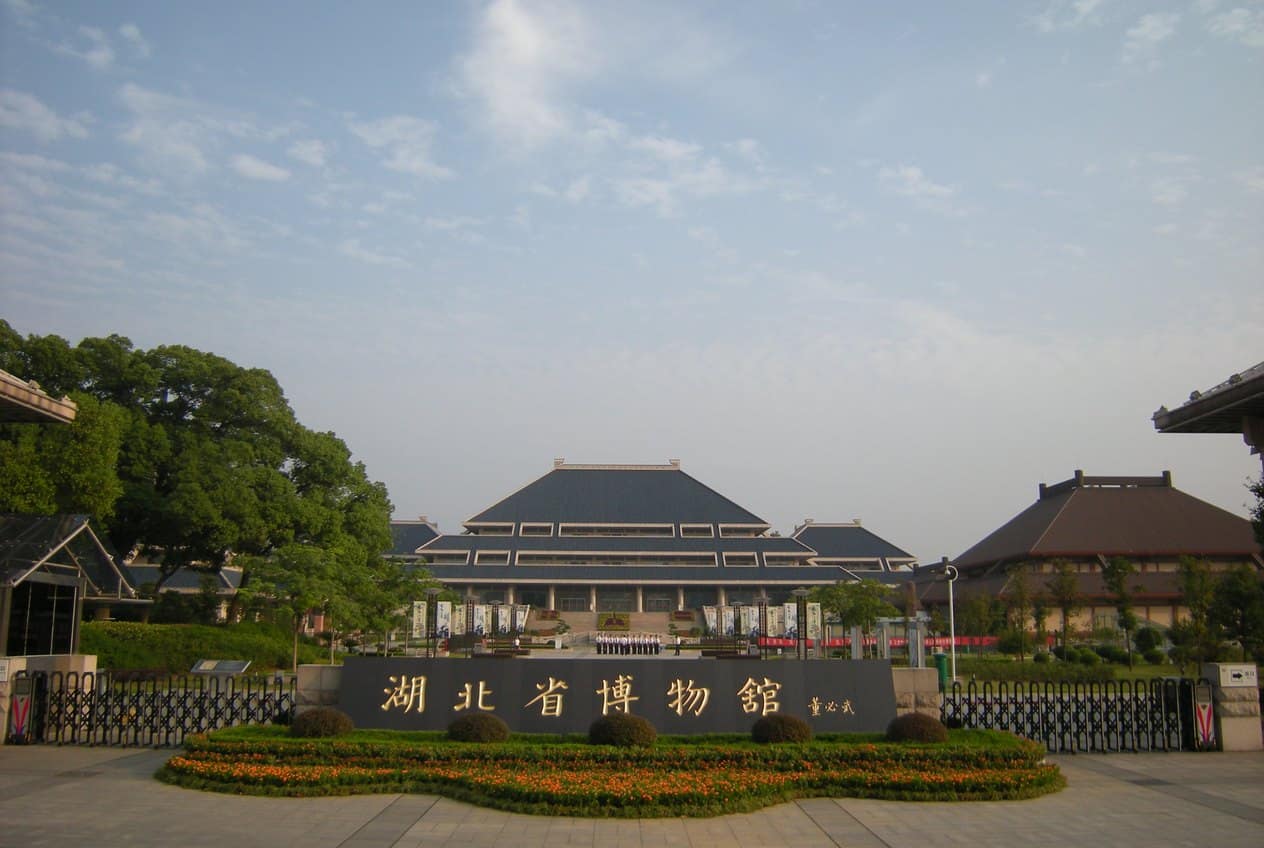
1Highlights
This is the one unmissable museum in Wuhan, and the reason is a single tomb. In 1978, a military construction crew near Suizhou cut into the burial of Marquis Yi of Zeng, sealed around 433 BC and never robbed. What came out included a set of 65 bronze bells hanging on their original timber-and-bronze frame, each bell capable of sounding two distinct pitches depending on where it is struck — a tuning system that had to be designed, cast and verified by people working more than two thousand years ago. The inscriptions on the bells amount to a surviving treatise on Chinese music theory. The other object people queue for is the sword of Goujian, excavated in 1965 from a Chu tomb at Wangshan near Jiangling. It is roughly two and a half thousand years old, its surface still carries a diamond lattice pattern, its inscription is still legible, and it has essentially not rusted. Between them these two objects make the case that the Yangtze states were not a provincial backwater of the northern Chinese heartland but a parallel centre with its own metallurgy and its own music. Admission costs nothing. Getting in, on the other hand, requires planning — and the planning is where most foreign visitors come unstuck.
- Where
- 160 Donghu Road, Wuchang — beside East Lake
- Admission
- Free for the permanent galleries
- Booking
- Real-name, timed, in advance — compulsory
- Closed
- Mondays, except public holidays
- Booking window
- Up to five days ahead
- Third-party booking
- The museum says none is authorised
- Nearest metro
- Line 8, Shengbo Hubei Ribao 省博湖北日报
- Time needed
- Two hours for the highlights, four with context
2Tickets
Free and open are two different things here, and conflating them is the commonest way to waste a morning in Wuchang. The permanent galleries carry no admission charge, and they also require a real-name, timed reservation made in advance through the museum's own channels. There is a daily release, a limit on how far ahead you can book, and a penalty for not turning up. The part that matters most for anyone shopping on travel platforms: the museum's own service page states that it has authorised no other website or third-party platform to provide entry booking. A paid product that promises to secure your admission is therefore operating outside the museum's system, whatever it says. Book it yourself, free, and treat any guiding or transport product as a separate purchase that does not include entry.
| Permanent galleries | Free | No charge, but a real-name timed reservation through the museum's own website or official WeChat account is compulsory. Carry the original document named on the booking |
|---|---|---|
| Chime-bell performance | ¥50 adult; concessions published | A separate paid performance inside the museum. Reserve museum entry first, then buy the performance ticket and choose a seat. Published concessions cover under-18s, 65–69s, students and military personnel, with over-70s free |
| Human guide and audio guide | Separately charged | Ask about English availability, coverage, deposit and return deadline. Paying for a guide is not a reservation — it does not get you through the gate |
| Third-party 'guaranteed entry' | Avoid | The museum states it has authorised no third-party platform to book entry. Treat any such offer with suspicion and book on the official channels instead |
No third-party platform is authorised to book your entry:This is stated on the museum's own service page, and it is worth taking literally. The listed official routes are the museum's own website and official WeChat account, alongside a small number of named government and partner channels. Anything else selling you entry — a tour product, an agency, a platform listing — is working outside that system, and the museum explicitly supports visitors complaining to such sellers over losses or disputes. The booking is free; there is nothing to buy. Guiding or transport products can still be worth money, but they should be priced and understood as not including admission.
Three no-shows suspend your booking rights for six months:A reserved slot that goes unused counts as a failure to attend, and the count does not reset at the end of a calendar year. Three of them and the account is blocked from booking for six months. There are also per-document limits on how many tickets one identity can hold for a given day. The practical implication for a trip with tight train connections: cancel a slot you know you cannot keep rather than simply not turning up, and do not book speculatively across several days to keep your options open.
Release time: the normal rule and the holiday exception:The museum's service page describes tickets for the newest bookable date being released at midnight, with booking open up to five days ahead and same-day tickets available only if stock remains. Around major holidays the museum has announced different, specific release times for particular dates in advance. Both are real — the midnight rule is the standing arrangement, and a holiday announcement overrides it for the dates it names. Check the booking interface itself for your date rather than trusting a figure quoted in any guide.
Foreign passports are accepted; check the field before you travel:Official material lists passports among accepted documents, and visitors who booked with a non-ID-card document present the original plus the order code for verification at the gate. What this page cannot confirm for you is the end-to-end registration experience with an overseas phone number or a particular name format. Open the official booking entry point, look at the actual fields, and if you are blocked, call the museum or ask your hotel to help communicate — before your travel date, not on the morning.
3Getting There
Metro Line 8 has a station named after the museum — Shengbo Hubei Ribao 省博湖北日报 — which makes this the easiest major sight in Wuhan to reach. The part worth getting right is which gate you walk to, because the museum's gates have assigned functions rather than being interchangeable entrances. Its service page designates the South Gate as the entrance for individual visitors, groups and tour-coach drop-off; the Southwest Gate for tour coaches and small self-drive vehicles; and the North Gate as the visitor exit and the large-luggage store.
Shengbo Hubei Ribao station 省博湖北日报. The museum is named in the station name, which makes navigation simple — but still walk to the correct gate rather than the nearest one
South Gate for individual visitors; Southwest Gate for small vehicles; North Gate is the exit and the large-luggage store. Follow current signs if arrangements change
Save the Chinese name and address — 湖北省博物馆,武昌区东湖路160号 — rather than relying on an English search. Ask to be dropped at the gate for individual visitors
There is a store for large bags, at the North Gate, with its own collection deadline. Ask on arrival about dimensions and the pick-up cut-off; keep your passport and valuables with you
Wuhan, Wuchang and Hankou are three different railway stations:They are in three different districts, tens of kilometres apart, and "Wuhan Station" is not shorthand for "Wuchang Station" — it is the newest and the furthest out, in eastern Wuchang. Hankou Station sits on the north-west bank and is the closest to Jianghan Road and the riverfront. Match the Chinese name printed on your ticket before arranging any onward transport. The same logic applies to the city itself: the Yangtze separates Wuchang from Hankou, so grouping your days by bank saves far more time than optimising a route within one day.
Three museums with confusable names:Hubei Provincial Museum is the one with the bells and the sword, in Wuchang on Donghu Road. Wuhan Museum is a different institution across the river in Hankou, on Qingnian Road. Jianghanguan Museum is inside the Customs House building on the Hankou waterfront. Three separate places, three separate admission arrangements, and a taxi driver given the wrong one will take you to the wrong bank of the Yangtze. When people say "the Wuhan museum" they almost always mean the provincial one — but say the full Chinese name to be sure.
4Route & Photos
Two hours covers the two objects people come for; four lets you understand why they matter. The museum has grown into several buildings and the layout has changed more than once, so plan by theme rather than by floor number and read the plan you are given on the day. A reasonable sequence runs from the prehistoric and Chu material, which sets up the craftsmanship, to the Zeng Hou Yi tomb, where it all arrives. The chime-bell performance is a separate paid experience in the South Hall basement, and it is genuinely optional.
Weekend evenings open only part of the museum:The museum runs a regular evening session at weekends and on public holidays, with closing extended into the evening. During the extended hours the South and North halls are open — which is not the same as everything being open. Guiding, dining, storage and the other halls may follow different schedules. If a specific exhibition is your reason for coming, confirm that it is part of the evening opening rather than assuming a later closing time covers the whole site.
Recommended Route
- 1
Arrive at your slot, not before it
Entry is by booked time window and the gate will not take you early or late. Clear the document check, then find the toilets, the seats and the plan of the day before walking into the first gallery.
- 2
Prehistoric craftsmanship, if open
Jade from the Shijiahe culture is the useful opening if the relevant displays are showing: it establishes that fine workmanship in this region long predates the bronzes. Read the dates and material notes rather than just looking at the objects — the point is the sequence.
- 3
Chu material language
With four hours, give the Chu-related exhibitions real time. Lacquer colour, animal forms and the uses of everyday objects together explain what kind of culture produced the tomb you are about to see. With two hours, skip this and come back only if energy allows.
- 4
The Goujian sword
Join the managed queue early, while the galleries are still thin. Look for the diamond lattice across the blade and the inscription near the hilt. A clear photograph is hard and not the point — this is an object to look at closely rather than to capture.
- 5
The Zeng Hou Yi tomb and the bells
Read the tomb context first, then the bell set as a whole. The thing to understand is the two-pitch design and what the inscriptions record about musical theory. Check the labels to distinguish excavated originals from replicas, performance instruments and digital reconstructions — all four appear in a visit like this.
- 6
Rest, or the performance
Sit down if anyone is flagging; you do not need to buy a show to justify a break. If you do want the performance, confirm the day's sessions and seating, and allow for waiting and entry time on top of the gallery time.
- 7
Finish, and decide about East Lake
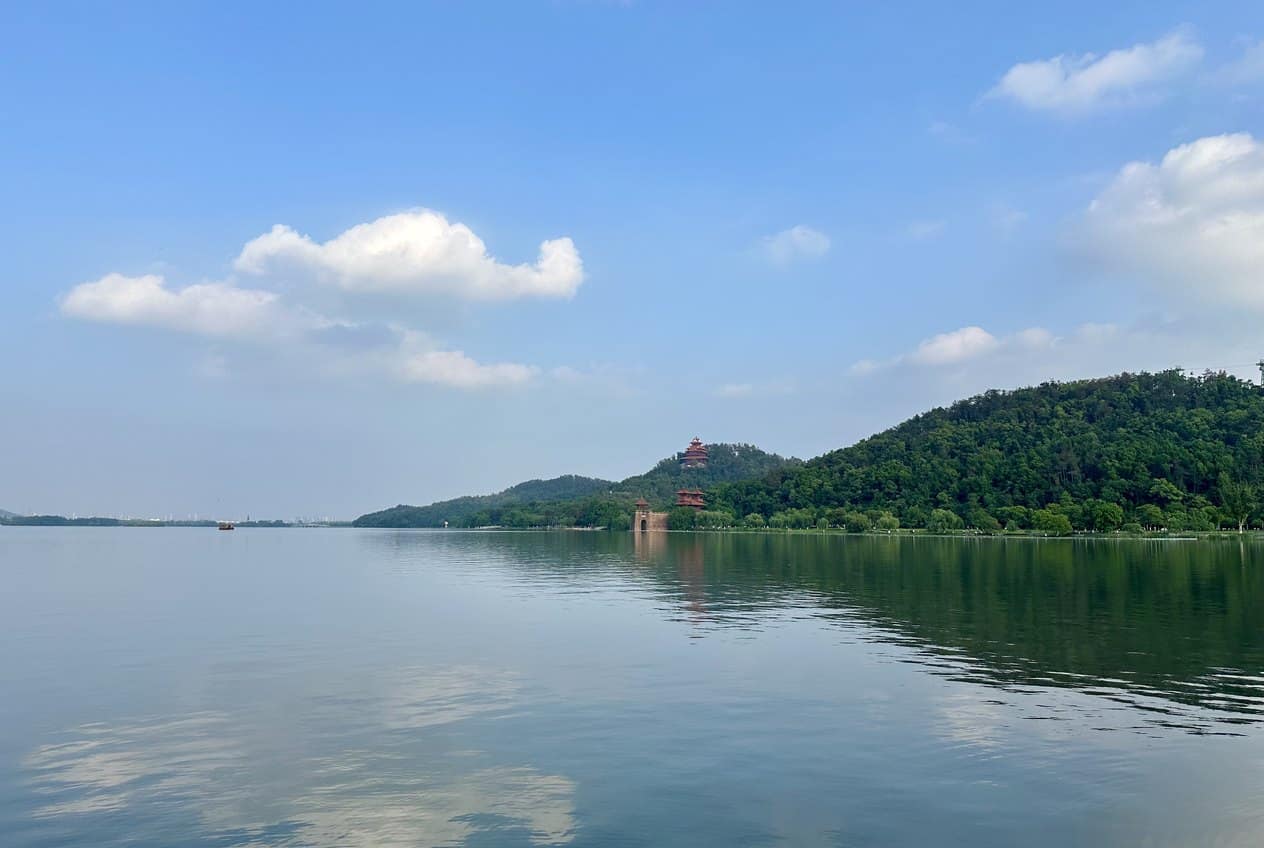
Collect luggage and return equipment before assessing daylight, weather and energy. Tingtao at East Lake is close enough to pair with the museum, which is why they share a day — but Moshan is a different area and needs its own planning.
Best Photo Spots
The sword, through glass
Photograph only where labels and staff allow, with flash off. Low light and reflections limit what is achievable, and the queue keeps moving — look properly first, then take one frame if you can.
The bell set as an arrangement
Stand where circulation stays clear and frame the whole rack rather than a single bell; the scale of the set is the thing that does not come across in a close-up. Follow the no-flash rule and any gallery-specific restriction.
The building and the lakeside
The exterior and the grounds are the place for tripods and wider shots, subject to asking first. The Donghu Road setting also makes the link to Tingtao obvious if you are continuing there.
5Food & Stay
| Eat before you enterPlanning | — | Leaving and re-entering is not a given, and your slot is timed. Have a proper meal on Donghu Road or Zhongbei Road before the booking rather than planning to come out halfway |
|---|---|---|
| Lotus-root ribs soupRegional dish | By the pot | The Hubei dish worth ordering on this side of the city. Meat stock, so vegetarians must ask about the broth rather than the visible ingredients |
| Hot dry noodlesBreakfast | Shop menu | Breakfast shops near Donghu Road and in hotel neighbourhoods. Wheat and sesame; ask about peanut and shared utensils if that matters to you |
| Simple vegetables with riceEveryday | Shop menu | A mild option around Zhongbei Road. Stir-fried vegetables are not automatically vegetarian — ask about meat stock, oyster sauce, egg and shared pans |
Where to Stay
- Donghu Road, Wuchang is the natural base if the museum and East Lake are your focus — it puts the whole Wuchang day within short reach. Confirm passport check-in and the actual walking distance to the metro before booking.
- Zhongbei Road, Wuchang works for combining shopping-area dining with the museum on the same side of the river. Check road noise and room orientation; a star rating does not guarantee English-speaking reception.
- Hankou is fine if the rest of your trip is over there, but the museum means crossing the river. Leave a transport buffer on the day you have a timed slot — the booking does not move for traffic.
6Tips & Pitfalls
- Free is not the same as walk-in. The galleries cost nothing and still require a real-name timed reservation booked in advance through the museum's own channels. Make the booking before you make any other plan for that morning.
- Treat a third-party 'entry guaranteed' product as a red flag. The museum states it has authorised no such platform. Book free on the official channels, and buy guiding or transport separately if you want them.
- Cancel a slot you cannot keep. Three no-shows block the account from booking for six months, and the count does not reset annually. This matters on a trip where a train might run late.
- Mondays are closed except on public holidays. The one fixed closure in a trip is the one most worth writing into the plan early, because it moves everything else around it.
- Display labels outrank travel posts. Flash, filming, bags and tripods are governed by the gallery you are standing in, and another visitor doing something is not evidence that it is allowed.
- Distinguish originals from replicas by the label. A visit like this will put excavated originals, reproductions, playable performance instruments and digital reconstructions in front of you, and a photograph of one looks much like a photograph of another.
- Published prices, opening hours and programmes change. Verify the official notice for your own travel date rather than trusting any guide, including this one.
- Carry your passport. Real-name booking and entry checks may ask for the original document, not a photograph of it.
7Frequently Asked Questions
If it is free, why do I need to book, and what if it is full?
Free describes the price of admission; the reservation controls how many people are inside and when they arrive. They are separate conditions, and satisfying one does not satisfy the other. Book through the museum's own website or official WeChat account, up to five days ahead — the service page describes the newest bookable date being released at midnight, with holiday periods sometimes given their own announced release time. Get a confirmed order before you arrange transport for that morning. If your date is full, try a different time slot or another day rather than arriving hopefully: there is no walk-in queue to join, and no paid service that can create a place. Nearby Tingtao at East Lake is the sensible fallback, weather permitting, and the museum publishes online exhibition content as well.
Can a travel platform book my entry for me?
The museum's own service page says it has authorised no other website or third-party platform to provide entry booking, and that it supports visitors who suffer losses or disputes in complaining to such sellers. Take that literally. A guiding product or a transport product can still be a reasonable purchase — a driver, a vehicle, an English-speaking guide all have real value — but none of them includes admission, and a listing that claims to guarantee entry is describing something the museum says it has not permitted. The booking itself is free and takes a few minutes on the official channels. If you have already bought a package that claims to cover entry, make your own reservation as well rather than assuming the package will work at the gate.
Does a performance ticket admit me, and are the original bells played?
No on the first, and you should not assume yes on the second. The chime-bell performance is a separately charged service inside the museum, and the official guidance is to reserve museum admission first, then buy a performance ticket and choose a seat — the performance ticket is not an entry ticket. Published prices run to ¥50 for an adult with several concession tiers, but sessions and arrangements change and the museum adjusts the schedule according to the day. On the instruments: viewing the excavated Zeng Hou Yi set and attending a musical programme are different experiences, and the name of a programme does not establish that archaeological originals are being struck in it. If that distinction matters to you, ask what instruments the session uses before buying.
Which gate do I use, and can I bring luggage?
The museum's service page assigns functions to its gates rather than treating them as interchangeable: the South Gate is the entrance for individual visitors and groups and the drop-off for tour coaches; the Southwest Gate is for tour coaches and small self-drive vehicles; and the North Gate is the visitor exit and the location of the store for large bags. So an individual visitor arriving by metro or taxi should head for the South Gate, and expect to leave by the north. On luggage: there is a large-bag store at the North Gate with its own collection deadline, so ask on arrival about size limits and the pick-up cut-off, and keep your passport and valuables with you rather than locking them inside a case. Museum storage is a convenience, not an airport baggage service.
Can I see the sword and the bells in two hours?
Two hours is a realistic budget for concentrating on those two and little else, provided you arrive at your slot rather than before it and queue for the sword early while the galleries are still thin. It is not enough to see the museum. Four hours lets you add the prehistoric and Chu-related displays, which is where the two famous objects stop being curiosities and start making sense as the output of a particular place and period. One caveat applies to any museum: reliable sources establish both objects as part of the collection, but maintenance, loans, display changes or crowd management can affect any individual case on any given day. Check the day's plan and notices on arrival rather than planning around a floor number you read somewhere.
8Sources and verification limits
The public sources behind the facts on this page. Titles are kept in their original language so they can be verified. Published prices, opening hours and programmes change — check the current official notice before you travel.
- 1.服务:开放时间、实名预约、入口分工与编钟演出购票湖北省博物馆官网 · undated
- 2.湖北省博开启常态化夜游,每周六、日约起湖北日报 / 荆楚网 · 2026-09-04
- 3.湖北省博物馆 Visitor Guide(英文指南)湖北省博物馆 · 2026-04-21
- 4.湖北省博物馆预约须知湖北省博物馆发布平台 · 2023-09-05
- 5.长江文明的鉴证 荆楚文化的精粹(曾侯乙编钟与越王勾践剑出土信息)湖北省文化和旅游厅 · 2020-12-14
- 6.不排队看勾践剑!湖博展览线上免费逛湖北省博物馆 · 2026-05-19
Combine With
Other Wuhan sights that genuinely pair well with this one
Before You Go
The practical guides you will actually need here
All Wuhan attractions
GoChinaTravel Editorial Team
Our team of China travel researchers combines on-the-ground contributor insights, official government sources, and traveler community feedback to create the most detailed English-language China guides available. Every guide is fact-checked against primary sources (NIA, 12367, official attraction websites, Railway 12306) before publication.