Ming Capital
Nanjing — Ming Tombs, Plane-Tree Boulevards and the Qinhuai River
A former imperial capital of shaded boulevards, Ming tombs and one of the longest surviving city walls on earth
📅Best Time
March–May and September–November
🗓️Stay
3 days (recommended)
✨Vibe
History · Green boulevards · River
Nanjing has been a capital of China on and off for over a millennium, and it wears that history with an ease other Chinese cities do not. Plane-tree boulevards shade a walkable centre; the Ming dynasty's first emperor is buried under a forested mountain; and the old city wall still stands as one of the longest surviving fortifications on earth. Along the Yangtze the city also carries the weight of twentieth-century history, and several of the country's most important museums. For a visitor, Nanjing is the most complete single-city introduction to Chinese history between Beijing's imperial grandeur and Shanghai's modernity — and much of it is free, provided you book the slots in advance.
✨ City Highlights
🏛️
Sun Yat-sen Mausoleum
A monumental memorial climbing 392 steps up a forested slope. Free, but it needs an advance reservation slot, and the burial chamber is closed on Mondays — check before you plan the day around it.
🪦
Ming Xiaoling Mausoleum
The tomb of the Ming dynasty's first emperor, with a stone-animal 'spirit way' through old forest. A UNESCO site and the city's most atmospheric spot. About ¥68-70 alone, or inside the ¥100 Zhongshan combined ticket.
🏺
Nanjing Museum
One of China's best, spanning jade, porcelain, calligraphy and a reconstructed Republican-era street. Free with an advance reservation slot, which sells out in peak season.
🏯
Zhonghua Gate & the Ming wall
A vast, well-preserved fortress gate you can walk through and climb, part of a wall that still wraps much of the centre. About ¥47, and the wall-top views are wide.
🏮
Confucius Temple & Qinhuai River
The old imperial examination district turned riverside quarter of lanterns and painted boats. Best after dark — and the city's most overpriced area for food.
🌊
Xuanwu Lake
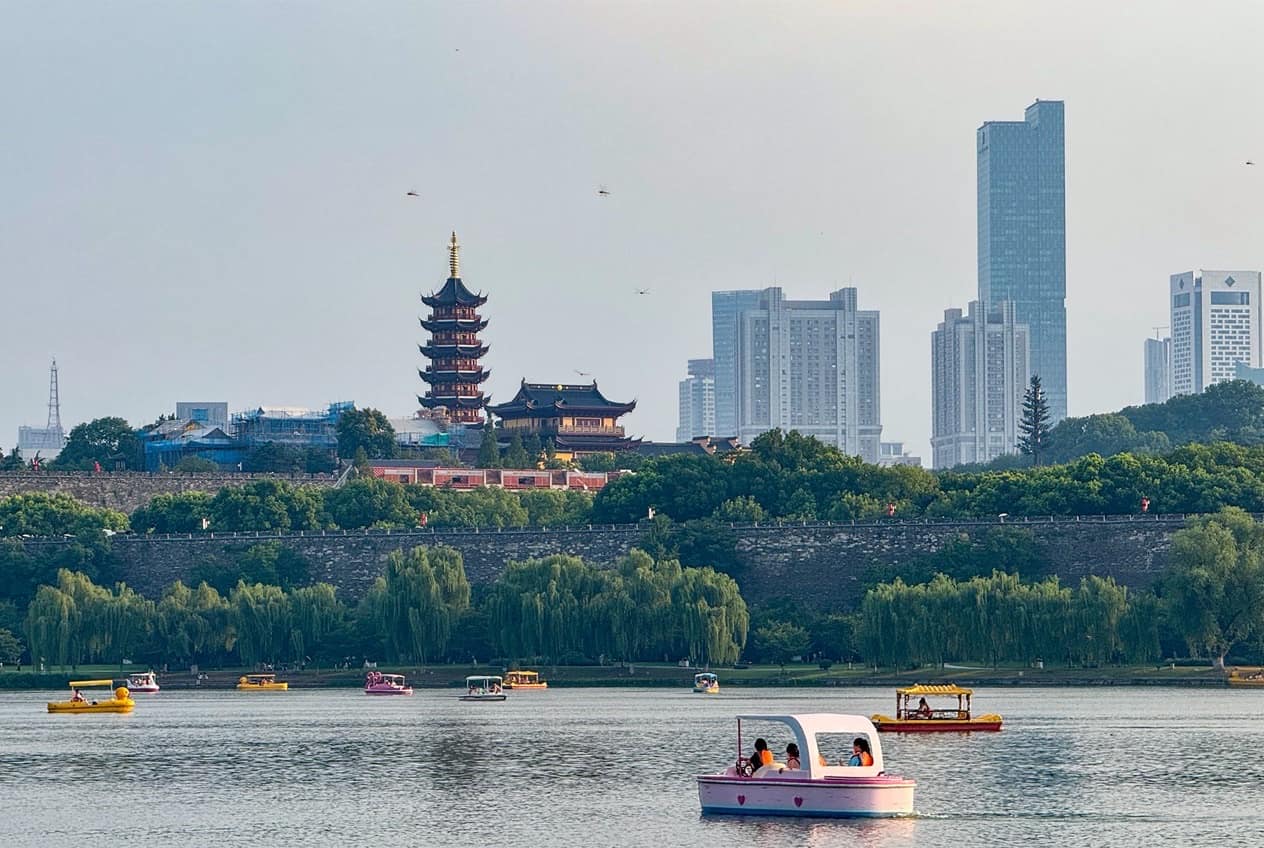
A large lake beside the wall and the old palace site, ringed by willows, with Purple Mountain reflected in the water. Free, and the calmest half-day in Nanjing.
📌 Insider Tips
- ▸Several of the best sights are free but require an advance reservation slot, and this is where visitors most often get caught out. Sun Yat-sen Mausoleum and Nanjing Museum both release slots about seven days ahead at 18:00 and sell out fast in peak season.
- ▸The Sun Yat-sen burial chamber is closed on Mondays. Plan Purple Mountain for another day of the week if seeing inside matters to you.
- ▸Buy the Zhongshan combined ticket, not singles. Ming Xiaoling, Linggu, Meiling Palace and the Music Stage bought separately come to roughly ¥145; the combined ticket is ¥100. It does not include Sun Yat-sen Mausoleum, which is free anyway.
- ▸Group the eastern hills into one day. Sun Yat-sen Mausoleum and Ming Xiaoling sit together in the Purple Mountain scenic area and are linked by shuttle — trying to split them across days wastes hours in transit.
- ▸Nanjing is part of China's visa-free transit network, with the current arrangement running up to 240 hours (10 days) for eligible nationalities, and it sits on the Beijing–Shanghai high-speed line about 1.5h from Shanghai. Confirm your own eligibility on an official source, as policy changes.
- ▸The Memorial Hall for the victims of the Nanjing Massacre is a place of mourning with its own etiquette — dress modestly, keep quiet, and consider carefully whether children are ready for it. Free, and also reservation-based.
- ▸Duck is the local obsession, and Nanjing's version is cold-served and subtle — salted duck, duck blood and vermicelli soup, duck-oil pastry. Nothing like Beijing's roast.
🗓️ Day-by-Day Itinerary
Curated routes — what to do, hour by hour
🏛️
Day 1
Purple Mountain — the Mausoleums
Both great tombs in one day, using the scenic-area shuttle.
- 🏛️08:30
Sun Yat-sen Mausoleum
Metro Line 2 to Muxuyuan, then the shuttle. A monumental memorial up 392 steps — free, but you need a reservation slot booked about a week ahead, and the burial chamber is closed Mondays. Mornings are quietest. Allow 1.5-2h.
- 🪦11:00
Ming Xiaoling Mausoleum
The first Ming emperor's tomb, with a stone-animal spirit way through old forest — the city's most atmospheric site. Use the ¥100 Zhongshan combined ticket rather than the ¥68-70 single. Allow 2h.
- 🍜13:00
Lunch: duck blood & vermicelli soup
Nanjing's comfort food — rich duck broth with vermicelli, blood cubes and tofu puffs, ¥15-30.
- 🏯15:00
Linggu Temple & Meiling Palace
Both are inside the combined ticket you already hold, and both are a short shuttle hop. Quiet, tree-shaded, and no extra cost.
- 🦆18:00
Dinner: salted duck
The city's signature — poached in brine, cooled and sliced. ¥40-80 a plate with a couple of cold dishes.
🍜 Food Highlights
The dishes you can't leave without trying
🦆Must Try
Salted duck
¥40-80
Brine-poached, cooled and sliced — subtle, fragrant, and the city's signature.
🍜Local
Duck blood & vermicelli soup
¥15-30
Rich duck broth with vermicelli and tofu puffs — the everyday bowl.
🥟Classic
Soup dumplings
¥15-35
Lighter and smaller than Shanghai's, eaten with vinegar.
🫓Everyday
Duck-oil pastry
¥5-15
Savoury sesame flatbread made with duck fat — a street staple.
🍠Iconic
Osmanthus taro
¥5-15
Sweet taro in fragrant osmanthus syrup, sold around the Confucius Temple.
💰 Budget (per person)
Backpacker / Mid-range / Luxury
| Category | 💚 Budget | ✨ Mid-range | 💎 Luxury |
|---|---|---|---|
| 🏨Accommodation | ¥80-250 | ¥300-600 | ¥900+ |
| 🍜Food per day | ¥80-150 | ¥200-350 | ¥500+ |
| 🪦Zhongshan combined ticket | ¥100 | ¥100 | ¥100 |
| 🏯Zhonghua Gate wall | ¥47 | ¥47 | ¥79 (night show) |
| 🏺Museums (reserve free) | Free | Free | ¥68 (guided) |
| 🚢Qinhuai night cruise | Skip — riverbank is free | ¥60-100 | ¥200 |
| Total | ¥300/day | ¥700/day | ¥1,600+/day |
Nanjing is excellent value because the heavyweight sights — Sun Yat-sen Mausoleum, Nanjing Museum, Xuanwu Lake — are free, and the food is famously cheap. The one deliberate saving is the Zhongshan combined ticket at ¥100 instead of about ¥145 in singles.
🏨 Recommended Hotels
| 🎒 | Budget | Hostels & inns | Confucius Temple / Gulou | ¥80-250 |
| 🏨 | Mid-range | Business hotels | Xinjiekou | ¥300-600 |
| 🏛️ | Boutique | Minguo-style hotels | Gulou / riverside | ¥500-1,000 |
| ✨ | Luxury | Ritz-Carlton / Shangri-La | Xinjiekou / Xuanwu | ¥900+ |
🗺️ Full Guide
🍜
Eat
- Salted duck (盐水鸭)
The city's signature: duck poached in brine, cooled and sliced, served at room temperature. Subtle and fragrant, and nothing like Beijing roast duck. ¥40-80 a plate.
- Duck blood & vermicelli soup
Nanjing's everyday comfort food — rich duck broth with vermicelli, duck blood cubes, offal and tofu puffs. ¥15-30 at any local shop, and better outside the tourist areas.
- Soup dumplings (汤包)
Smaller and lighter than Shanghai's, eaten with a spoon and vinegar. ¥15-35 a basket.
- Duck-oil pastry & osmanthus taro
The classic street pair — a savoury sesame flatbread made with duck fat, and sweet taro in osmanthus syrup. ¥5-15 each around the Confucius Temple.
🏨
Stay
- Xinjiekou
The commercial centre and the practical choice: metro Lines 1 and 2 cross here, so both the eastern hills and the Confucius Temple are direct. Business hotels at ¥300-600.
- Gulou / the boulevards
The university and Republican-era district — plane-tree streets, Minguo-style boutique hotels and the city's better neighbourhood restaurants. Quieter and more characterful.
- Confucius Temple area
Cheapest for hostels and closest to the Qinhuai night views, but the noisiest and the most touristy for food. Good if the river is your priority.
🚇
Getting Around
- Metro
Clean and extensive, reaching the eastern hills, Xuanwu Lake and both rail stations for ¥2-8 with an Alipay or WeChat QR code. Line 2 serves most of the main sights.
- Purple Mountain shuttle
Inside the Zhongshan scenic area, a shuttle links Sun Yat-sen Mausoleum, Ming Xiaoling, Linggu and the Music Stage. Use it — the sites are further apart on foot than the map suggests.
- Walking the boulevards
The centre is genuinely walkable and shaded by plane trees, which turn golden in autumn. The stretch through Gulou is the nicest urban walk in the city.
- High-speed rail
Nanjing South is on the Beijing–Shanghai line — about 1.5h to Shanghai, 3.5h to Beijing, 1h to Hangzhou. Check whether your train uses Nanjing South or Nanjing station.
✅ Pre-Departure Checklist
Tick these off before you leave home
⚠️ Heads-Up & Things to Avoid
- ⚠Free does not mean walk-in. Nanjing Museum and Sun Yat-sen Mausoleum both need a reservation slot released about seven days ahead at 18:00, and they sell out in peak season. Book on the official channels before you travel.
- ⚠The Sun Yat-sen burial chamber is closed on Mondays. Several guides omit this and visitors arrive to find the main interior shut.
- ⚠The Qinhuai River district is the city's most tourist-trappy for food and souvenirs, with inflated prices and persistent touts. Enjoy the lanterns, then eat in the university or residential districts.
- ⚠The Memorial Hall for the victims of the Nanjing Massacre is a place of mourning, not a standard attraction. Maintain quiet, dress modestly, and be prepared for emotionally heavy content.
- ⚠July and August are Nanjing's notorious 'furnace' months — hot and very humid. Spring and autumn are markedly better, and autumn is when the plane trees are at their best.
Sort Your Visa First
Entry rules that matter for this city, including visa-free transit options.
Visa240-Hour TransitHow China's 240-hour (10-day) visa-free transit works in 2026: eligible nationalities, the 60+ entry ports, how the clock is counted, cross-province travel rules, onward-ticket requirements and common mistakes.VisaEntry PortsComplete list of the airports, land and sea ports where China's 240-hour visa-free transit applies in 2026, which provinces they serve, and how to plan an open-jaw itinerary that enters and exits at different cities.
Where to Go Next
Routes travellers actually take from here — with rail times and why the pairing works.
Modern MetropolisShanghaiThe easiest hop in China: 1.5 hours on the Beijing–Shanghai line, imperial capital to modern metropolis.Gardens & CanalsSuzhouAn hour away, and the natural pairing — Ming tombs and city wall, then classical gardens and canals.Peaks & Hui VillagesHuangshan2.5 hours south for the mountain and the Hui villages, a complete change of scenery.
Before You Go
The practical guides you'll want open on your phone while you're here.
High-Speed RailHow to use China's high-speed rail network as a foreign visitor: booking with a passport, what G, D, C, K and T trains mean, seat classes compared, station procedures, luggage rules and the routes worth taking.Best time to visitWhen to visit China by month and region, why Golden Week and Chinese New Year are the two weeks to avoid, and how to pick dates for the Great Wall, Guilin, Harbin or Yunnan.Etiquette & customsPractical Chinese etiquette for travellers: tipping, table manners, who pays, gift-giving, queueing, photography, and the small number of things that genuinely cause offence.Paying in ChinaComplete guide to paying in China as a foreign visitor: setting up Alipay and WeChat Pay with an overseas card, the 3% fee threshold, whether cash still works, ATM charges, tipping, and what to do when a payment is declined.
Explore other cities
GoChinaTravel Editorial Team
Our team of China travel researchers combines on-the-ground contributor insights, official government sources, and traveler community feedback to create the most detailed English-language China guides available. Every guide is fact-checked against primary sources (NIA, 12367, official attraction websites, Railway 12306) before publication.