Route overview
Seven days is the shortest trip that can hold three Chinese cities without turning into an airport-and-station blur, and Beijing–Xi'an–Shanghai is the route that earns it: an imperial capital, the single most extraordinary archaeological site in the country, and a city that looks like the future, connected by two high-speed legs that each take less time than the equivalent flight once you count airports. The order matters and it is not arbitrary. Beijing and Shanghai both have major international hubs, so flying into one and out of the other — an open-jaw ticket — removes a wasted backtrack that would otherwise eat most of a day. Xi'an sits between them on the rail network, which is why it goes in the middle rather than tacked on. What this page does differently from a generic seven-day list is plan around three constraints that only appear once you cross cities. A seven-day trip contains exactly one Monday, and Monday closes the Forbidden City, the Shaanxi History Museum and Yu Garden — three of this route's anchors, in three different cities. Where that Monday falls decides what you lose, and there is one placement that costs you almost nothing. Rail tickets go on sale on a rolling fifteen-day window counted from each departure date, not from the start of your trip, which means the two train legs cannot physically be booked in the same sitting. And each of these cities has several main stations that are not interchangeable — the Beijing station you leave for Xi'an from is not the one you would use for Shanghai. Every stop below carries a time so you can see where the slack sits, and each major sight links to its own guide for tickets and opening rules.
| Length | 7 days, 6 nights |
|---|---|
| Cities | Beijing (3 nights) → Xi'an (2) → Shanghai (1+) |
| Best for | First visit to China |
| Between cities | Two high-speed rail legs, no domestic flights |
| Flights | Open-jaw: into Beijing, out of Shanghai |
| Book ahead | Forbidden City, both rail legs, Shaanxi History Museum |
| Watch out | One Monday lands mid-trip |
- Day 1Land in Beijing and stay outdoorsNothing timed, nothing ticketed hours ahead. A park and a lane walk are the only things worth planning on a day your body clock is wrong.
- Day 2The imperial axisThe Forbidden City is the one appointment in Beijing you cannot move. Everything else today is built to be walkable from it.
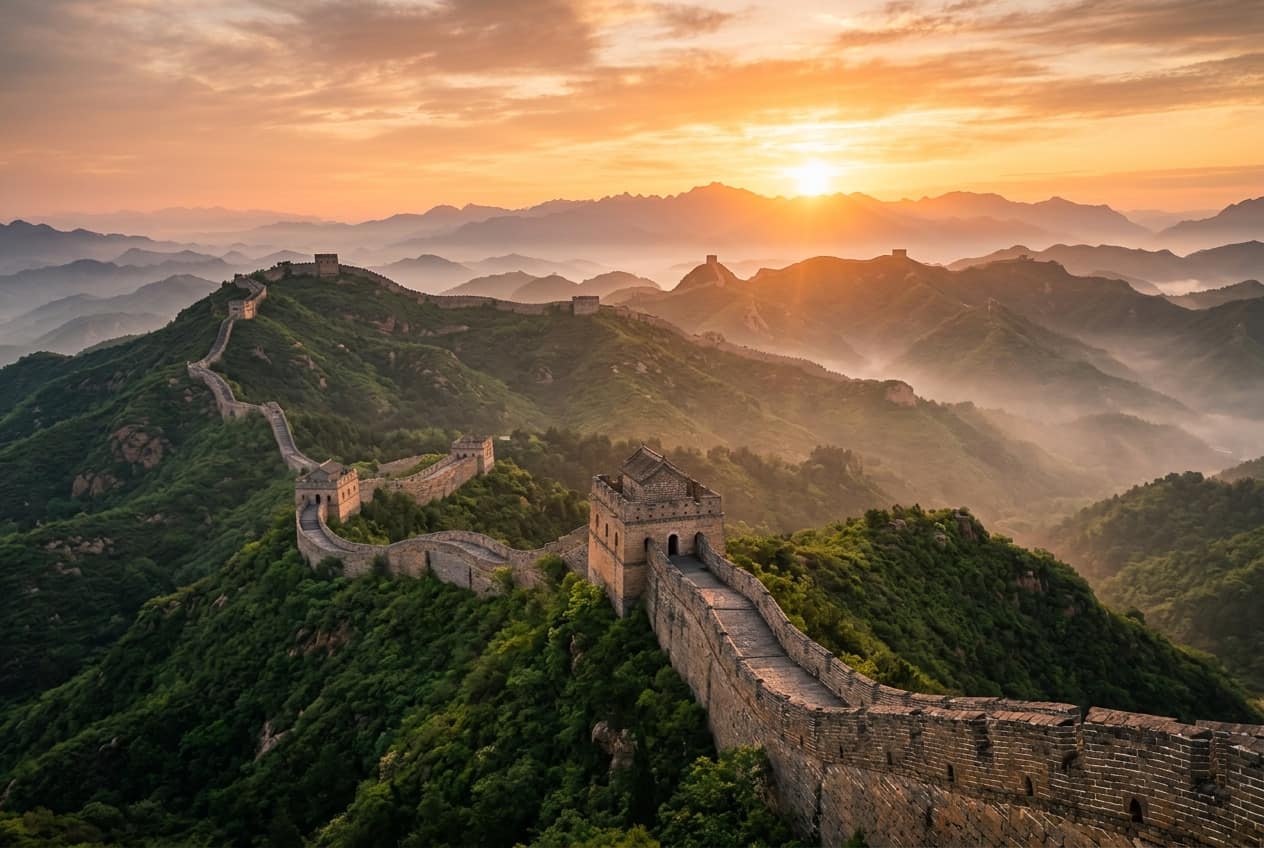
- Day 3The Great Wall, all dayA full-day round trip out of the city. The most common way to ruin this day is to put a second sight in it.
- Day 4Summer Palace, then the train to Xi'anA half day in Beijing's garden capital, then roughly four and a half hours of high-speed rail. You arrive in time for dinner, not for sightseeing.
- Day 5Terracotta Army and the city wallThe Monday-proof day. Put your Monday here if you have one: the Terracotta Army and the wall both run daily.
- Day 6The long leg, then the Bund at duskThe awkward train of the trip. Take the fast one and you land with an afternoon; take a slow one and the day is gone.
- Day 7Old Shanghai, new Shanghai, then outA garden, a tower and a flight. Two of the three are closed or pointless on the wrong day, so read the notes before you fix the order.
Day 1
Land in Beijing and stay outdoors
Nothing timed, nothing ticketed hours ahead. A park and a lane walk are the only things worth planning on a day your body clock is wrong.
- Morning
Arrive, clear immigration, get to the city
Beijing's airports are both a long way out. The airport rail links are faster than a taxi in traffic and drop you on the metro network, but do the SIM or eSIM activation before you leave the terminal — the data is what makes everything else on this trip work.
- 14:00
Temple of Heaven
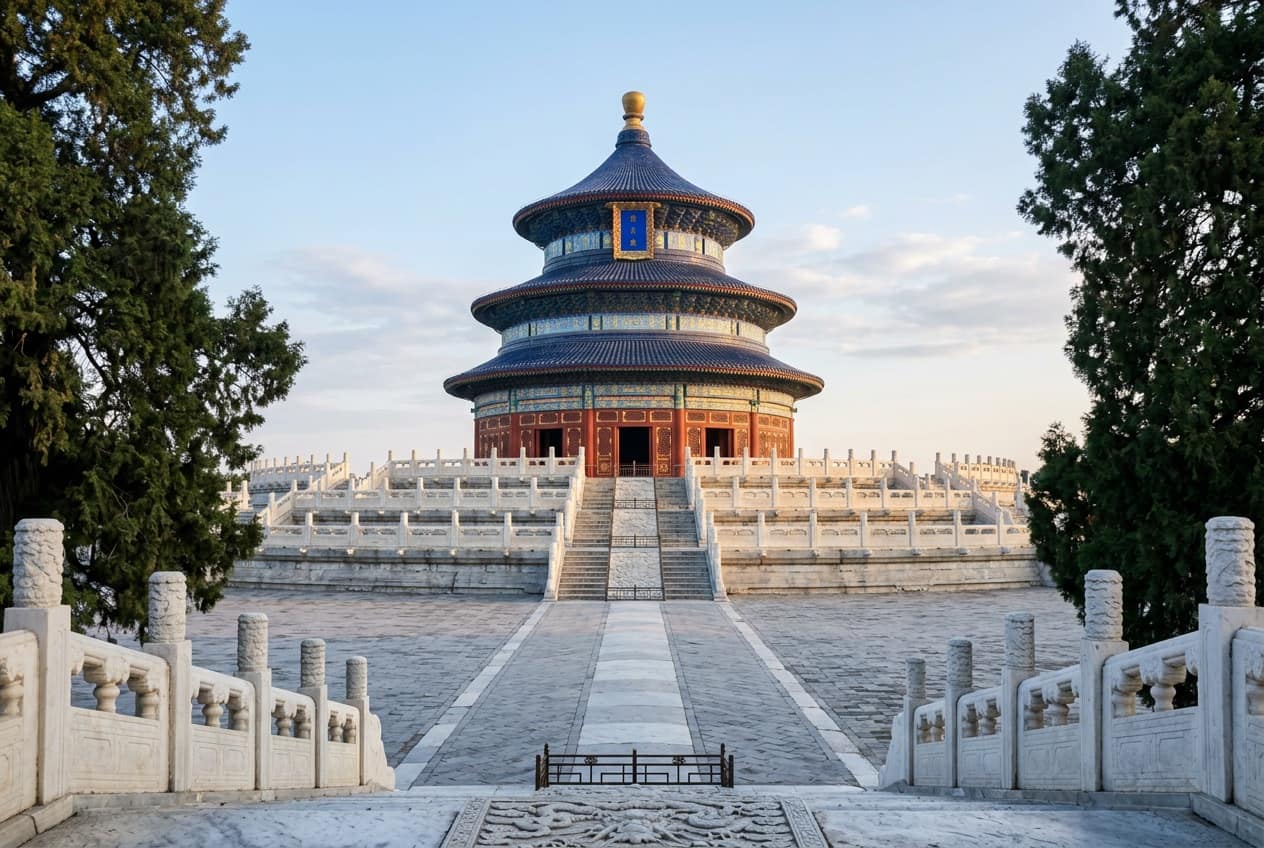
The right first sight precisely because it asks nothing of you: a huge walled park rather than a timed-entry museum, so arriving vague and late costs nothing. Come in from the south gate to walk the ritual axis in the order the emperor did.
- 16:30
The park, not just the altar
The outer grounds are where Beijing's retirees play cards, sing opera and dance, every afternoon, and it is the single easiest unstaged thing to watch in the city. Give it the half hour most itineraries skip.
- 18:30
Hutong dinner and a slow walk
Head for a lane neighbourhood and eat early. Jet lag will hit hard around 20:00 — being a ten-minute walk from your hotel when it does is the whole point of putting this on Day 1.
Day 2
The imperial axis
The Forbidden City is the one appointment in Beijing you cannot move. Everything else today is built to be walkable from it.
- 07:30
Tiananmen Square
Go early, and note that the square itself now has its own entry procedure with a passport check — treat it as a separate step before the palace, not a space you drift across.
- 09:00
Forbidden City, north through the axis
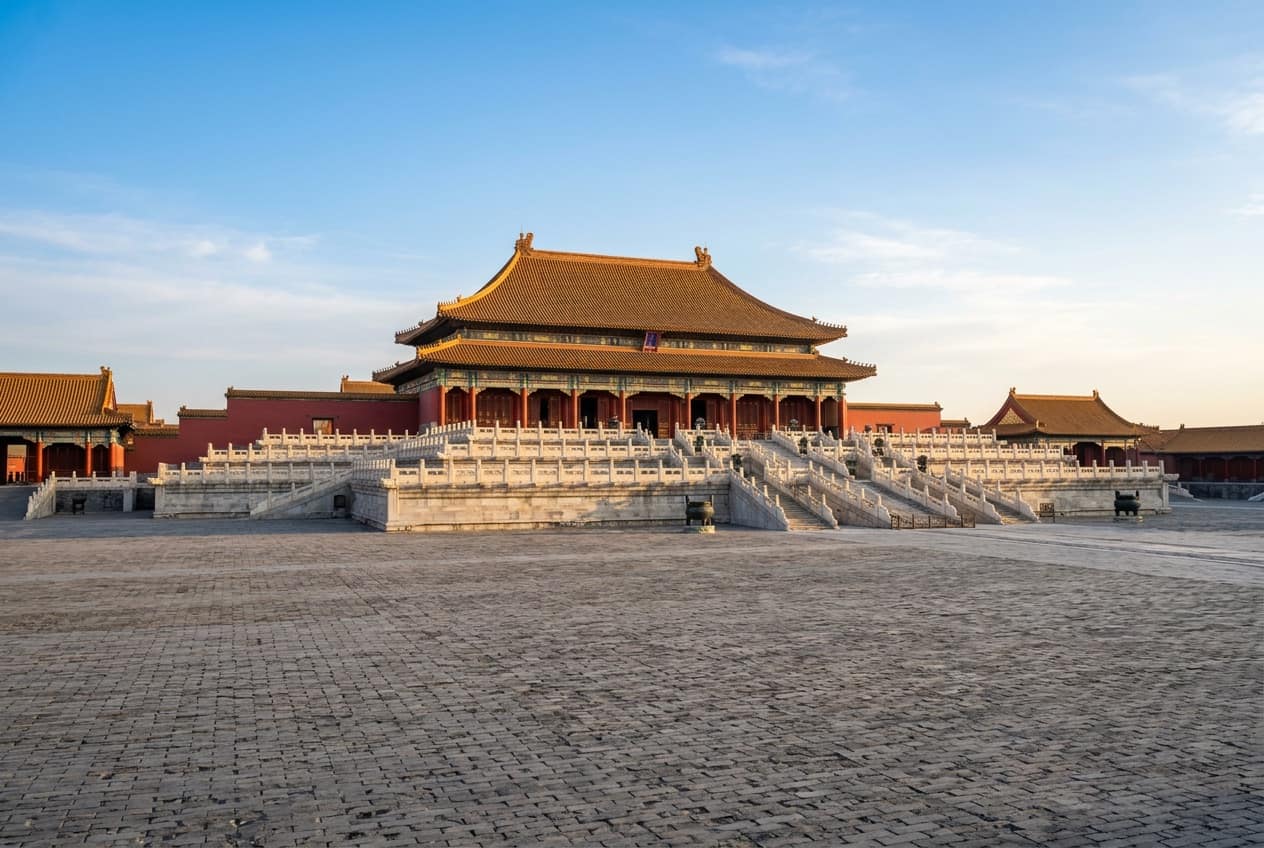
Enter at the Meridian Gate and walk north; the route is effectively one-way, so you cannot double back for something you skipped. Your reservation is tied to a date and your passport, and the palace is closed Mondays.
- 12:30
Jingshan Park, straight out of the north gate
Fifteen minutes uphill for the view that explains what you just walked through — the entire palace laid out below as one symmetrical plan. Do this immediately after, while the layout is still fresh.
- 15:00
Beihai Park or the lakes
An imperial lake park next door, and the natural decompression after three hours of courtyards. If your legs have had enough, a lakeside tea house does the same job.
- 18:00
Peking duck, booked
The good duck houses take reservations and fill up. Book it the day before — this is the one meal on the route worth planning rather than wandering into.
Day 3
The Great Wall, all day
A full-day round trip out of the city. The most common way to ruin this day is to put a second sight in it.
- 07:00
Leave the city early
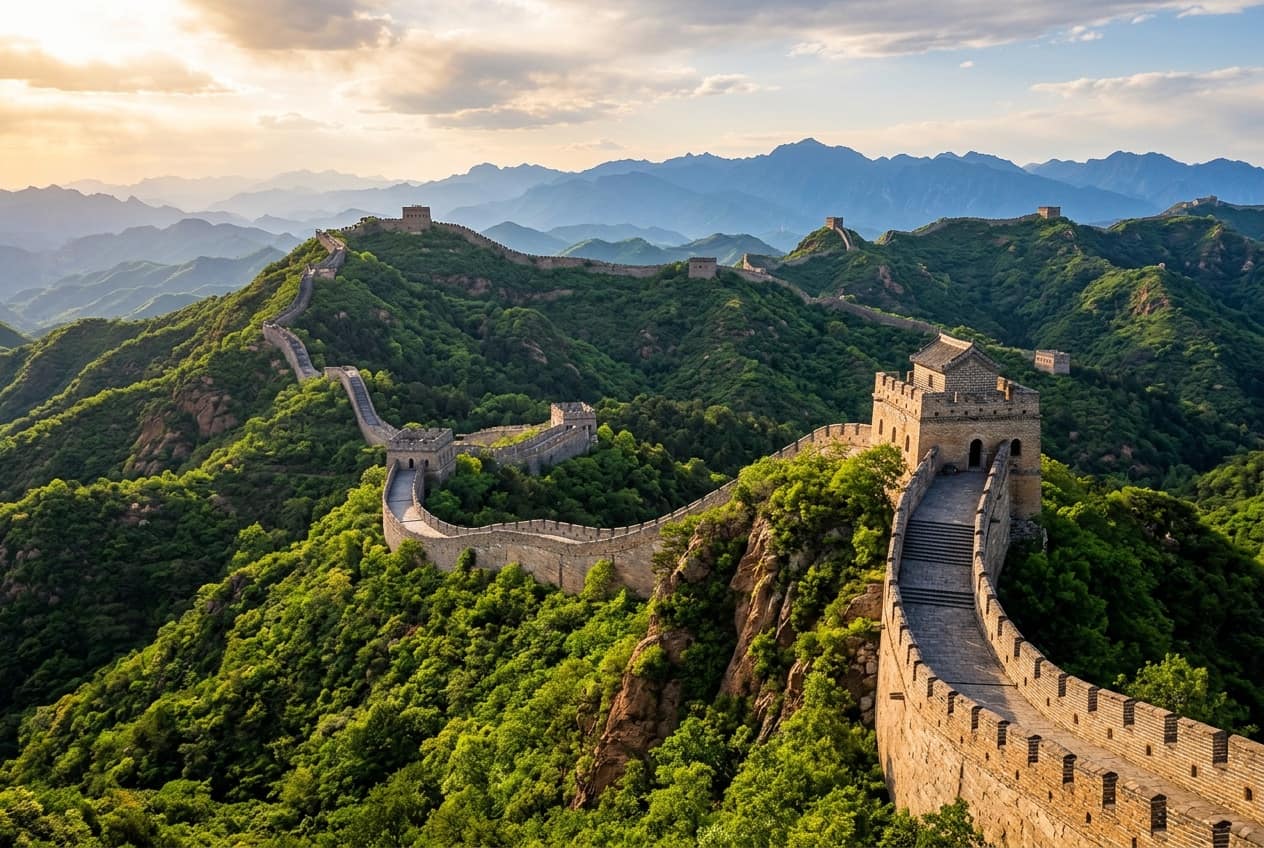
Mutianyu is roughly 70 km north-east and about 1.5 hours each way by car. Arriving near opening buys you the quietest hour on the wall; the coach groups land after 10:00.
- 08:30
Settle the gate question at the base
Mutianyu's enclosed gondola and its chairlift-plus-toboggan are run by two different companies, their tickets do not transfer, and each admits through a different entry gate. Decide your way up and down before you buy, not at the barrier.
- 09:30
Up, then west along the ridge
The restored stretch climbing west through forest is the photograph everyone comes for. It is a continuous ascent on uneven steps — turning back two towers short costs you very little of what there is to see.
- 13:00
Down by toboggan, if you want it
A steel track you brake yourself, which stops selling in the late afternoon — earlier than the park closes — and shuts in rain or strong wind. If this is why you chose Mutianyu, build the day backwards from it.
- 15:00
Late lunch in the valley
The valleys around Huairou farm rainbow trout in cold stream water and grill it to order. It is the genuine local dish out here and a much better use of the hour than the site canteens.
- 19:00
Back in Beijing, pack
Tomorrow starts with a train. Repack tonight so the morning is a taxi and a station, not a search for a charger.
Day 4
Summer Palace, then the train to Xi'an
A half day in Beijing's garden capital, then roughly four and a half hours of high-speed rail. You arrive in time for dinner, not for sightseeing.
- 08:00
Summer Palace, in at the North Gate
China's largest imperial garden, and a deliberate contrast to Day 2: landscape with buildings in it rather than the reverse. Entering at the North Gate puts Suzhou Street inside the door and sends you up and over the hill — the fastest way to the Buddha Incense Pavilion.
- 09:30
Over the hill, down to the Long Corridor
Note the two clocks here: the park gates open around dawn but the ticketed courtyards open about two hours later, so an early arrival and a combination ticket are two different plans. Exit east or south — the park is not a loop and walking back costs an hour.
- 12:00
Collect bags, head for Beijing West
Xi'an services run from Beijing West, which is not the station you would use for Shanghai. Allow an hour in hand: security, the manual passport lane and the walk to the gate are three separate queues.
- 15:00
High-speed rail to Xi'an North
Roughly four and a quarter to four and a half hours on the fast services, with departures through the day. Some trains terminate at the older city-centre station instead and take substantially longer — check which one your ticket says.
- 19:30
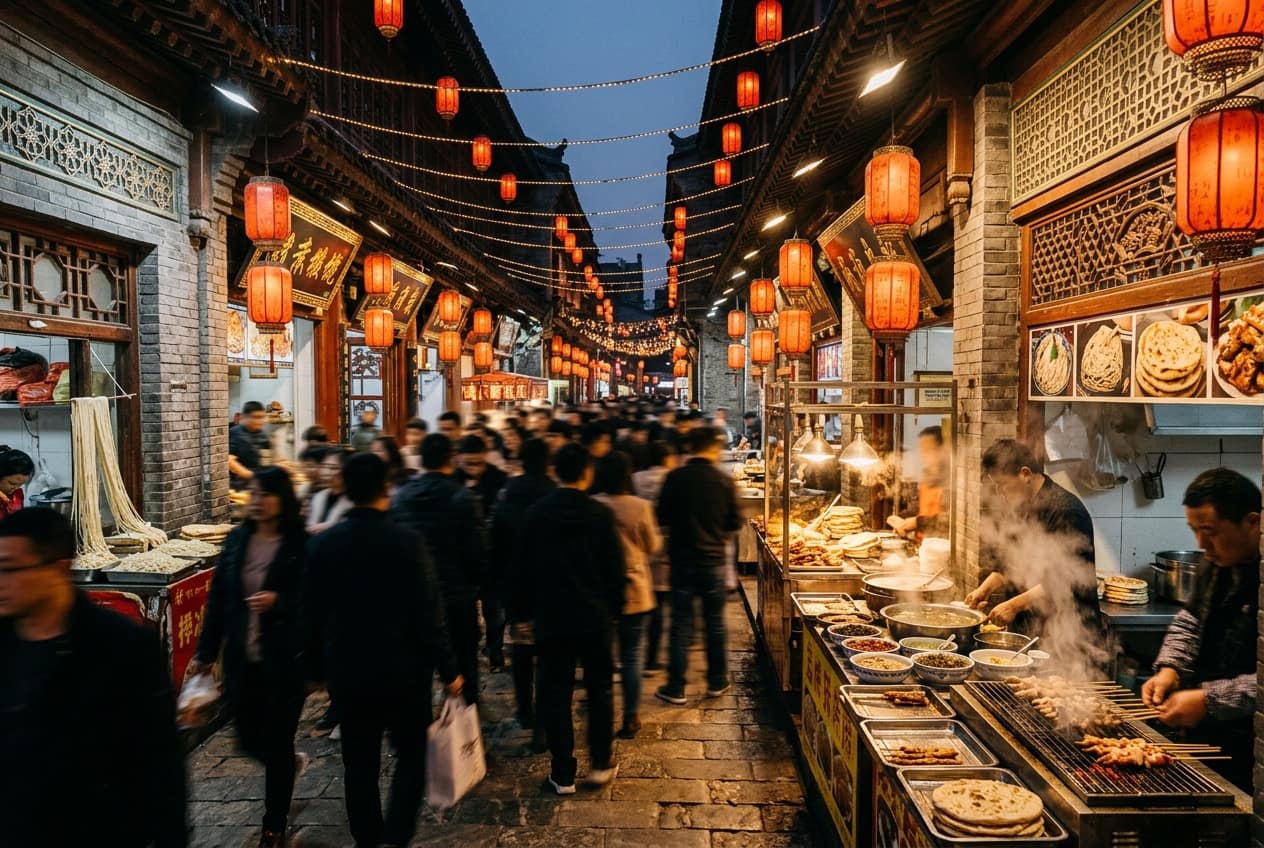
The Muslim Quarter, one turn off the main street
Arrive, drop bags, walk out to eat. The lantern-hung street everyone photographs is the most visitor-priced part of a district of about a dozen lanes — turn off it into the side lanes for the version locals queue at.
Day 5
Terracotta Army and the city wall
The Monday-proof day. Put your Monday here if you have one: the Terracotta Army and the wall both run daily.
- 08:00
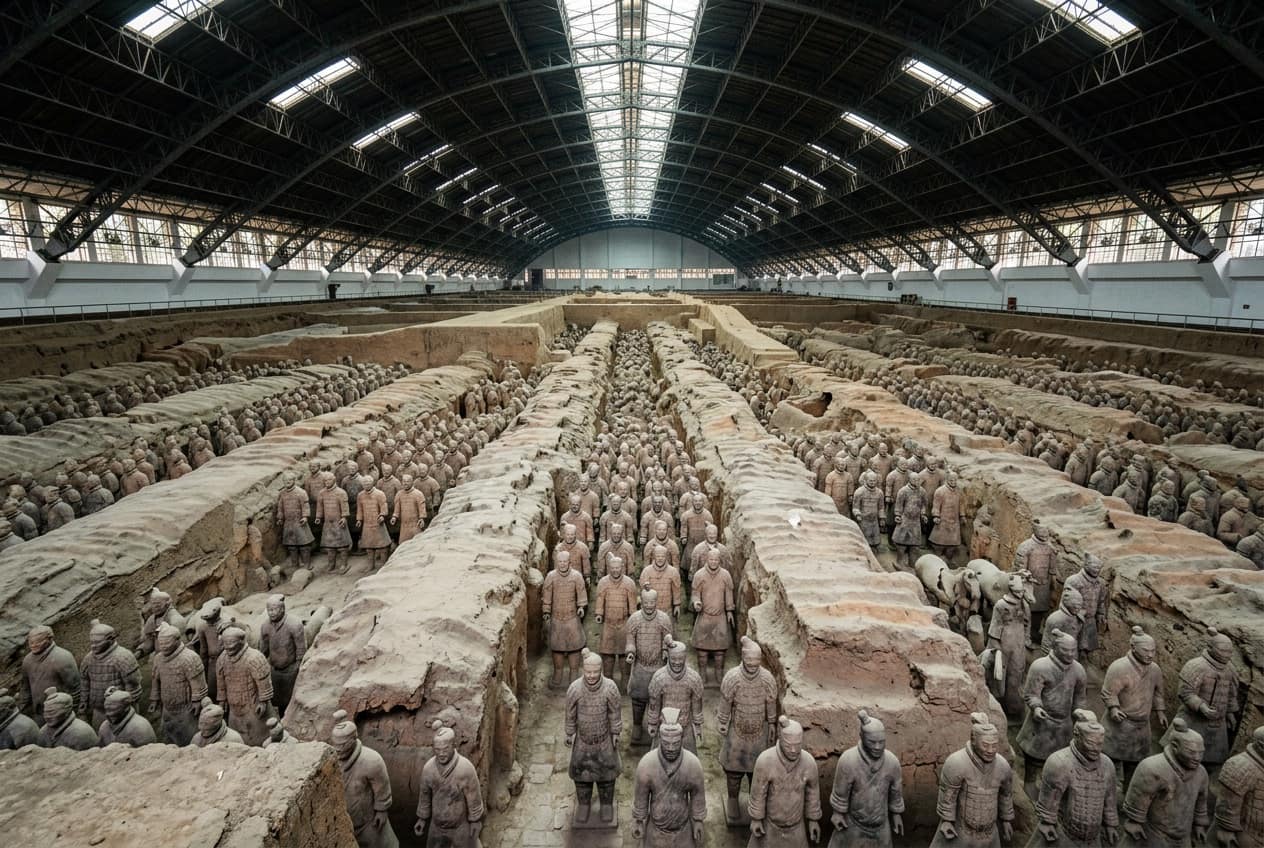
Out to the Terracotta Army
About an hour north-east of the city. Go early: the pits are a one-way route with no doubling back, and the first hour is the only one where Pit 1 is photographable over the heads in front of you.
- 09:30
The three pits, in order
Pit 1 is the one everyone pictures, but Pit 3 is the command post and Pit 2 holds the partially excavated ground that shows you how the site is actually worked. Free admission categories still need a real-name reservation here.
- 12:30
Lishan Park — same ticket, 2 km away
The detail most guides miss: one ticket covers both parks, a free shuttle runs between them, and the bronze chariots — the finest objects on the site — were moved out of the pit museum into a dedicated hall here. Skipping this is skipping what you already paid for.
- 16:00
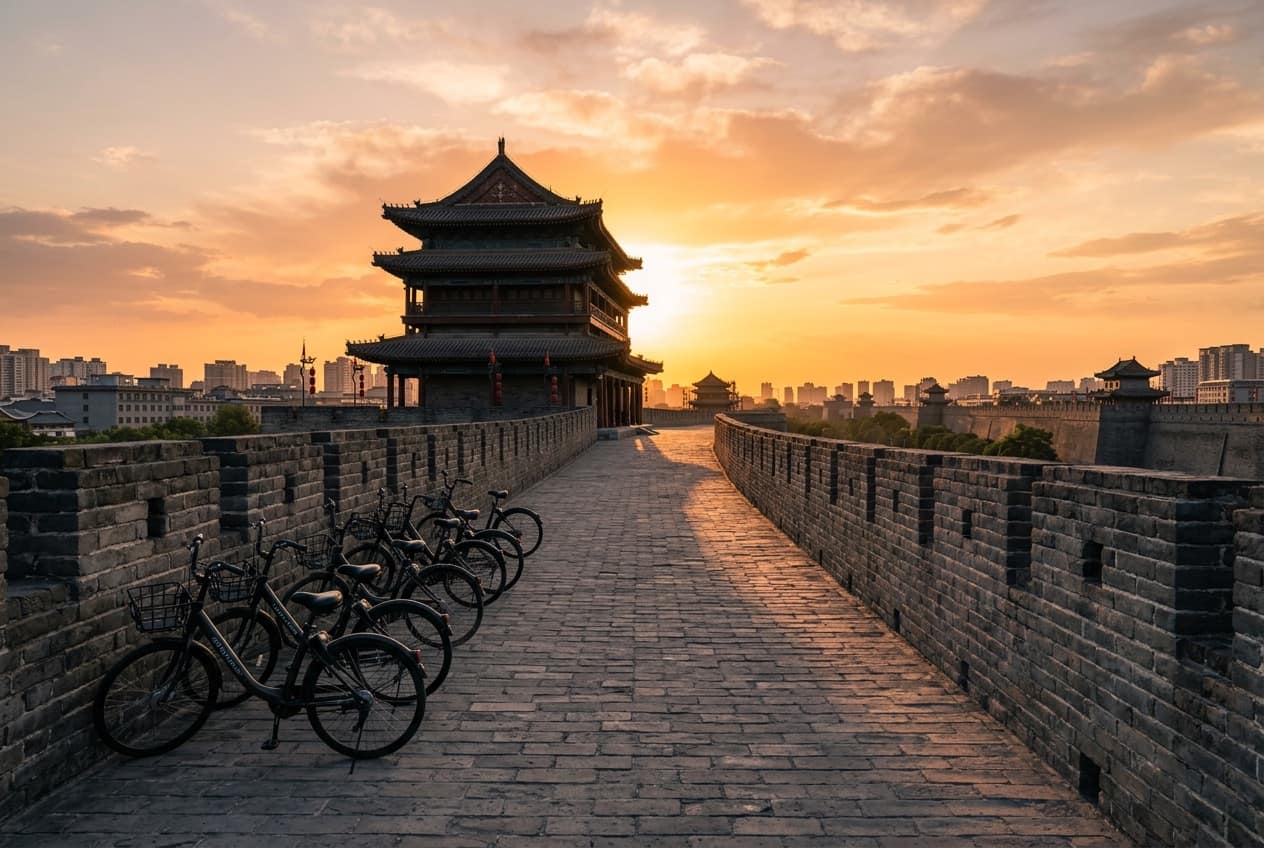
Xi'an City Wall at the golden hour
A complete 13.74 km circuit you can cycle, and the best way to understand the grid the city still runs on. Two constraints: the bike counter stops renting earlier than the gate stops admitting, and age limits bar both small children and older visitors from cycling.
- 19:00
Dumplings, or the museum if it is not a Monday
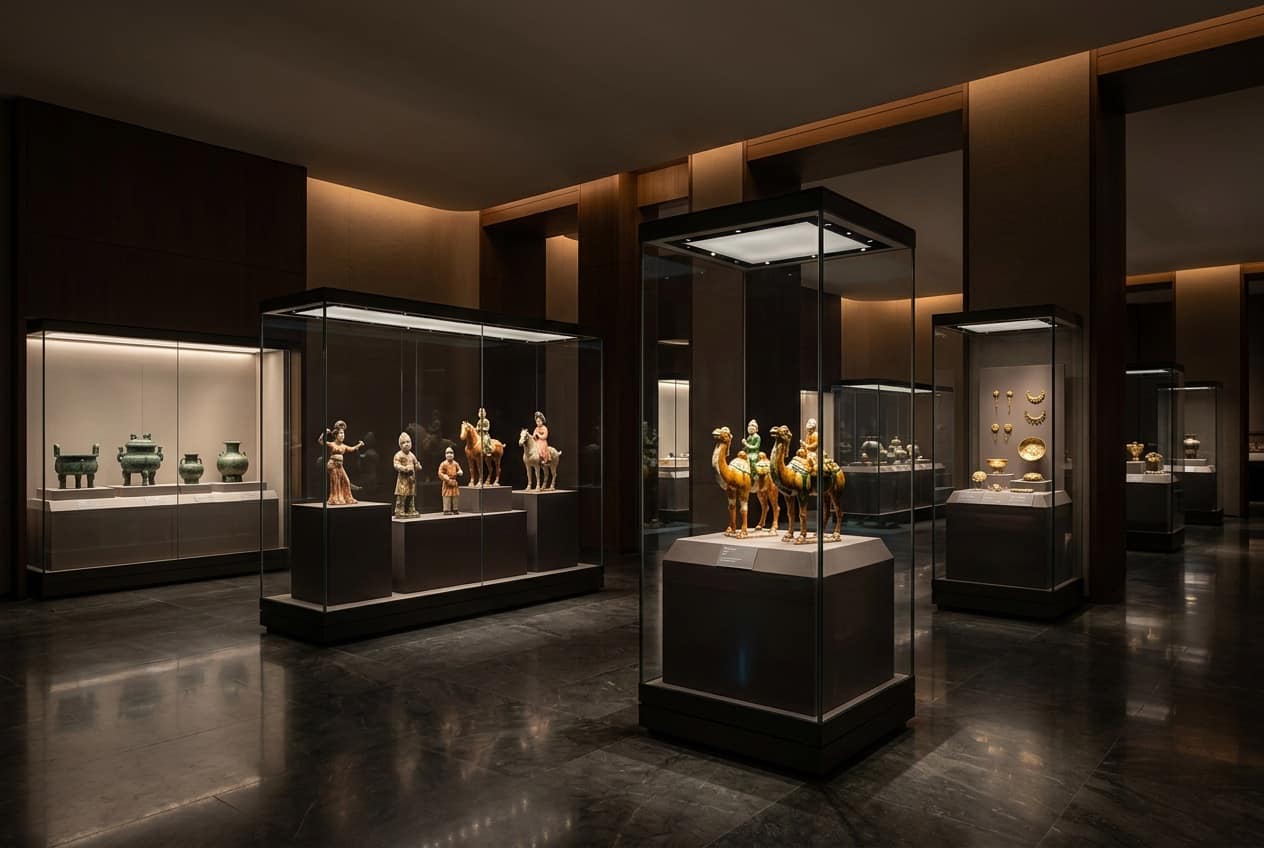
If your Day 5 is not a Monday, swap an hour of the wall for the Shaanxi History Museum — free admission that still requires a booking, usually several days ahead. If it is a Monday, the museum is shut and you have lost nothing by being here today.
Day 6
The long leg, then the Bund at dusk
The awkward train of the trip. Take the fast one and you land with an afternoon; take a slow one and the day is gone.
- 07:30
Early start for Xi'an North
This is the leg to get right. Only a couple of services cover Xi'an to Shanghai in under six hours; most take seven to nine. The difference is not a slightly later lunch — it is whether Day 6 contains Shanghai at all.
- 08:50
High-speed rail to Shanghai Hongqiao
On the fastest service, a shade under six hours, arriving early afternoon. Eat before boarding: station food courts before security are better and cheaper than the trolley.
- 15:00
Into the city, drop bags
Hongqiao is on the metro network and connected to the airport you probably fly out of tomorrow — worth noting now rather than discovering it at 05:00.
- 16:30
The Bund, and the half of it nobody tries
Walk the waterfront, then try the doors: many of the historic banking halls along here are open to the public for free during business hours, and almost no visitor pushes one. That is the Bund's other half.
- 17:45
Cross to Pudong on the public ferry
The defining photograph of the Bund cannot be taken from the Bund — it comes from the promenade opposite, which the public ferry reaches in about ten minutes for a couple of yuan. It outperforms the tour boats on every measure that matters.
- 18:30
Blue hour, from the right bank
The window after the facade lighting comes on and before the sky goes fully black is the shot. The lighting runs to a published schedule that differs at weekends and shifts between seasons, so check it rather than assuming it stays on late.
Day 7
Old Shanghai, new Shanghai, then out
A garden, a tower and a flight. Two of the three are closed or pointless on the wrong day, so read the notes before you fix the order.
- 08:30
Yu Garden, the walled one
Three separate places share this name and only the walled Ming garden charges admission — the bazaar, the Nine-Bend Bridge and the Mid-Lake Pavilion outside it are free. The garden closes on Mondays outside public holidays and stops admitting in the late afternoon while the bazaar outside stays busy, so nothing on site warns you.
- 10:30
The bazaar, then the City God Temple
The free half, and where almost every photograph tagged Yu Garden actually comes from. The temple is a third site again with its own ticket.
- 12:30
Lujiazui — but check the sky first
Visibility is the product here. At 546 m you are often inside cloud when the ground is merely overcast, so look at the sky before buying rather than after. On a clear day the height buys reach; on a hazy one the lower observation decks are the better call, and the famous shot of all three towers is taken for free from the pavement below.
- 15:00
Or the former French Concession instead
If the sky is grey, trade the tower for plane-tree streets, 1920s villas and coffee. It is the better wet-weather Shanghai and it needs no ticket, no booking and no visibility.
- 17:00
To the airport
Shanghai's two airports are a long way apart and the maglev only serves one of them. Confirm which you are flying from — and allow for the fact that the metro ride across the city is longer than it looks on the diagram.
Before you go
Work out which day of the week each day falls on before you book anything else. A seven-day trip always contains one Monday, and on this route Monday closes the Forbidden City (Day 2), the Shaanxi History Museum (Day 5) and Yu Garden (Day 7). The cheapest place for it is Day 5 in Xi'an: the Terracotta Army has no routine Monday closure and neither does the City Wall, so a Monday there costs you one museum you can swap for the wall at sunset. If your Day 2 or Day 7 lands on a Monday, shift the whole trip by a day.
You cannot book both train legs on the same day. Tickets are released on a rolling window of roughly fifteen days counted from each train's own departure date, with the exact release hour varying by station. The Beijing–Xi'an leg (Day 4) comes on sale two days before the Xi'an–Shanghai leg (Day 6) does. Set two reminders, not one — and if you are travelling over a national holiday, the fast Xi'an–Shanghai service can be gone within minutes of release.
Check the station name, not just the city name. Beijing has several main stations and the one serving Xi'an is not the one serving Shanghai; Xi'an's high-speed services use a different station from the older city-centre one, and there is a third to the east. Shanghai's high-speed arrivals are not all at the same station either. A booking confirmation that says only "Beijing" is not enough information to get in a taxi with.
Your passport is your train ticket — bring the physical one you booked with. China's rail system is paperless for passport holders: there is nothing to collect and nothing to print. Automated gates are built around domestic ID cards and often cannot read a foreign passport, so every station keeps a staffed lane for manual checks. Allow 45 to 60 minutes at these three cities' main stations for your first couple of trips, because security, the identity check and the walk to the gate are three separate queues.
Set up mobile payment and a ride-hailing app before you fly, and sort out data. All three cities run on phone payments, and the places on this route where cash gets awkward fastest are exactly the interesting ones — hutong lanes, the Muslim Quarter food streets, the village at the foot of the Great Wall. Airport SIM counters exist but queuing for one after a long-haul flight is the worst possible use of your first hour.
Pack for one climate change, not three. Beijing and Xi'an are northern and dry with wide day-night temperature swings; Shanghai is coastal and humid. In autumn and winter the Great Wall ridge and the top of a Xi'an city wall both run several degrees colder than the streets below, while Shanghai rarely needs the same layer.
Opening hours, reservation channels and daily caps all change. Open the individual guide linked under each day and confirm the official notice for your date before you set out — especially for anything that needs booking days in advance.
Stops on this route
Open an individual guide for tickets, opening hours and how to get there.
Forbidden City
The world's largest surviving palace complex — 24 emperors, 600 years, 9,999 rooms. Reservation-only, closed Mondays.
Mutianyu Great Wall
The restored Great Wall section most foreign visitors prefer — and the one where buying the wrong lift ticket sends you to the wrong gate.
Temple of Heaven
Often called China's most perfect building. Come at 6 AM for tai chi and choirs, or Friday night for the lit Hall of Prayer.

Summer Palace
China's largest imperial garden opens at dawn — but the ticketed courtyards inside do not open for another two hours, and five different gates start you in five different places.
Terracotta Army
One ticket covers two parks about 2 km apart — the three excavated pits and Lishan Park, where the two bronze chariots now stand. Many visitors leave without realising the second half was already paid for.
Xi'an City Wall
A 13.74 km Ming-dynasty rampart you can ride right around in under two hours — if you get the gate, the rental clock and the age limits right before you climb up.
Shaanxi History Museum
Free to enter, but you cannot walk in — the museum's own phrase is free admission still needs a ticket, and the booked slot is the whole planning problem.
Xi'an Muslim Quarter
It is not one street. The lane everyone photographs is the most expensive place to eat in it, and the food locals queue for is one turn away.
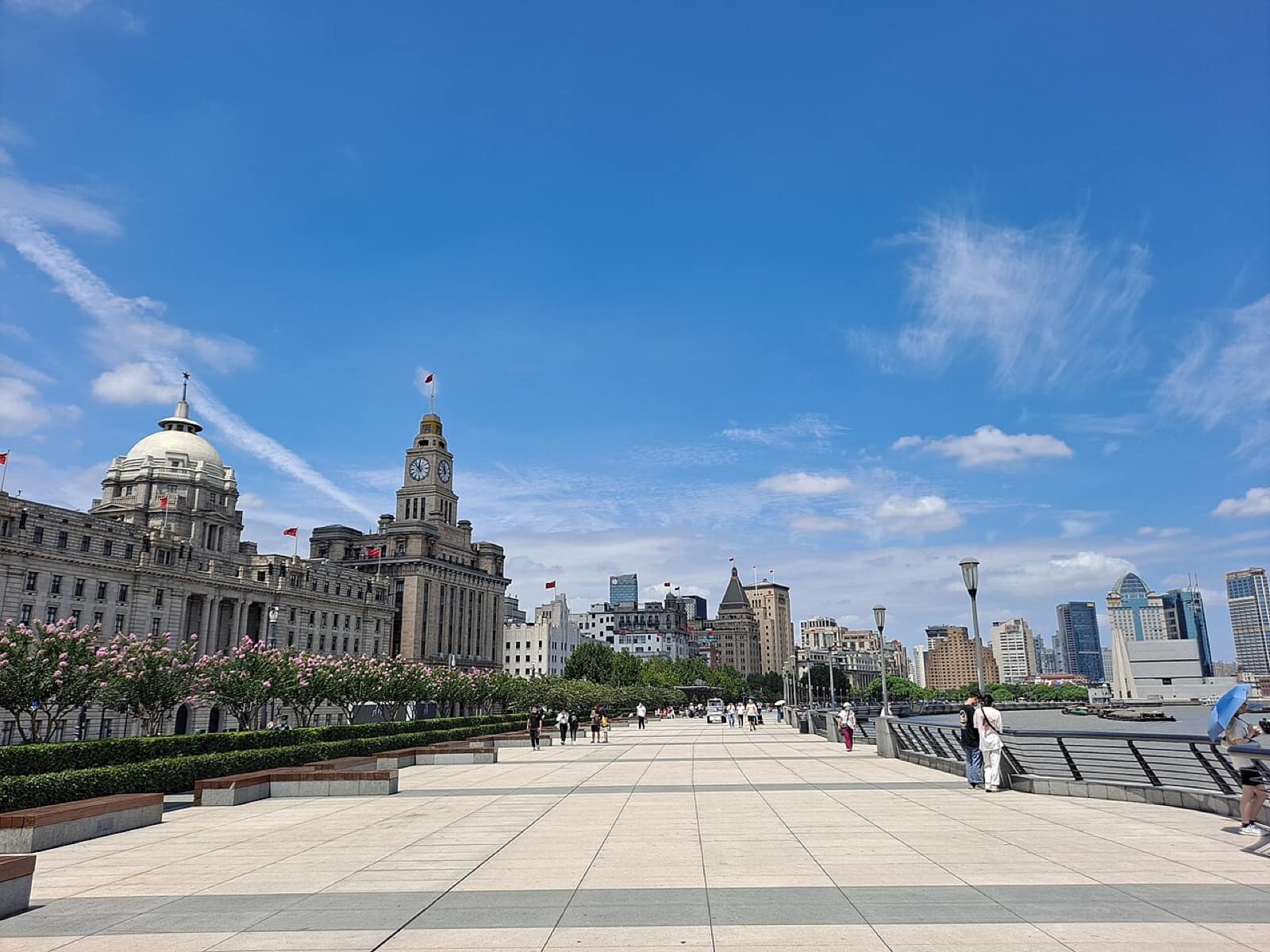
The Bund & Nanjing Road
The lights go off on a schedule, the best view is from the opposite bank, and the crossing costs two yuan. Almost nobody plans around any of the three.
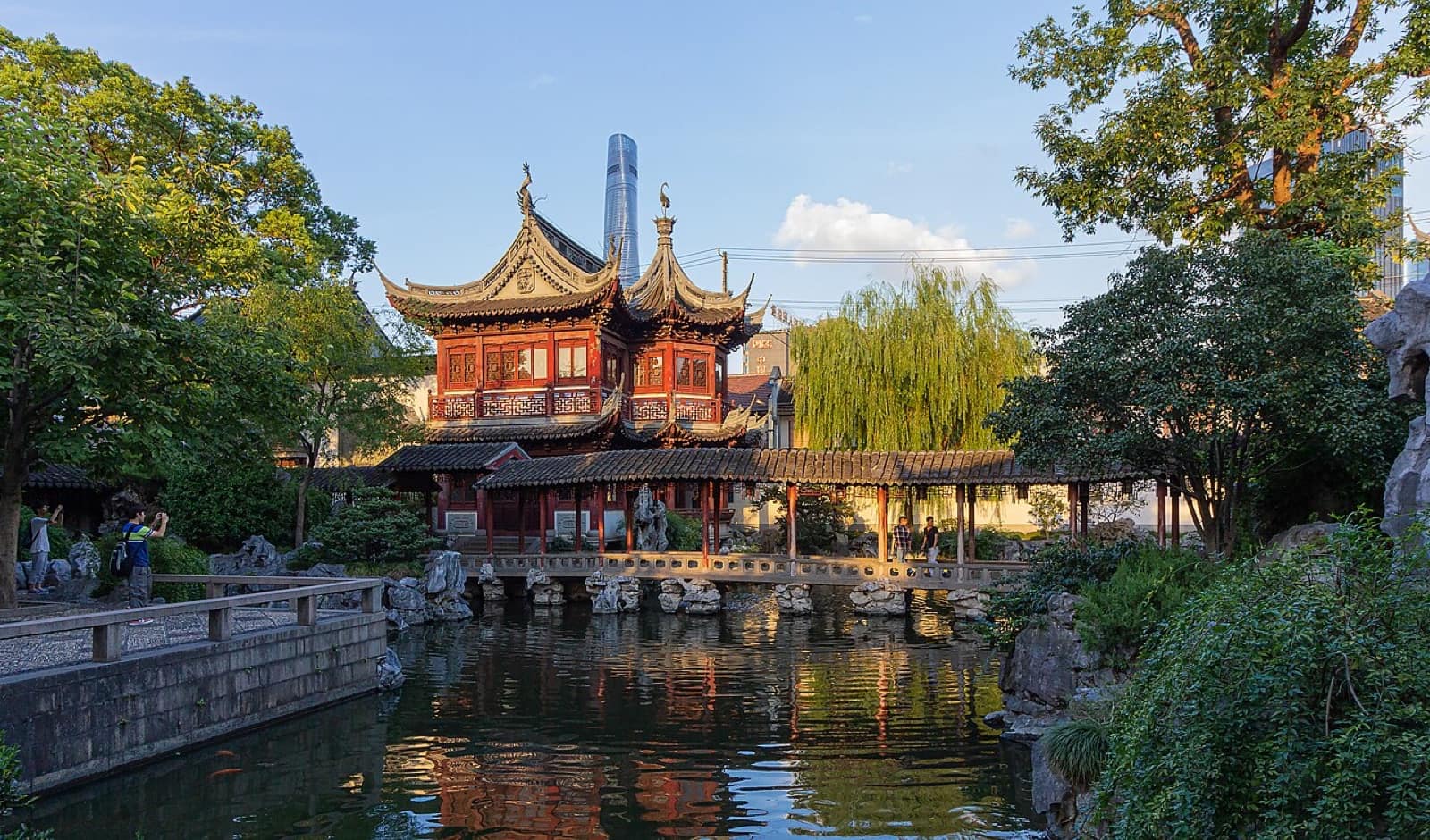
Yu Garden & Bazaar
Three different places share this name, and only one of them charges. It also closes on Mondays and shuts at 4.30pm — which is why so many people photograph the bridge and never see the garden.
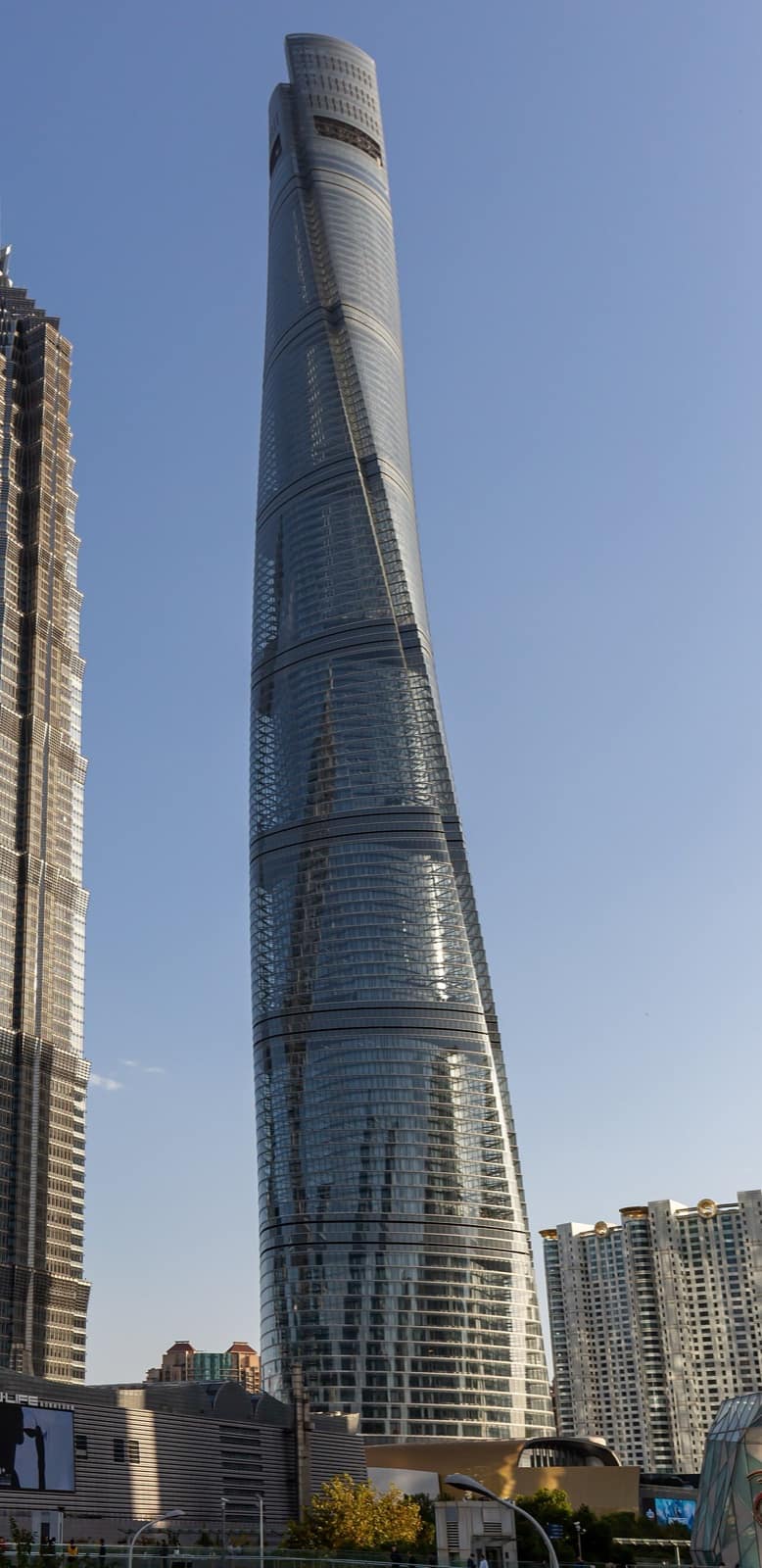
Shanghai Tower
The tallest of the three towers is not automatically the best one to go up, and on a hazy day none of them is worth the ticket. Check visibility before you buy.
Practical reading
The practical guides you will actually use on this trip.
FAQ
Is one week enough for Beijing, Xi'an and Shanghai?
Yes, if you accept that it is three cities at three nights, two nights and one-and-a-half. Seven days covers the imperial core and one Great Wall section in Beijing, the Terracotta Army and the city wall in Xi'an, and the Bund plus one more thing in Shanghai. What it does not cover is a second Great Wall section, a Xi'an day trip to Mount Hua, or Shanghai Disneyland — each of those needs a whole day and there is no spare one. If any of them matter to you, plan nine or ten days rather than squeezing.
Why Beijing to Shanghai and not the other way round?
Either direction works on the rail network, but Beijing first has two practical advantages. The Forbidden City needs an advance reservation and is closed Mondays, so putting it on Day 2 means you are fixing your hardest constraint while the rest of the trip is still flexible. And Shanghai is the easier city to be jet-lagged or tired in — it asks less of you on arrival than Beijing does, so it is the better place for the end of a trip rather than the beginning. Reversing it is fine if your flights dictate it; just move the Monday logic with you.
Should I take trains or domestic flights between these cities?
Trains, on both legs. Beijing to Xi'an is a little over four hours of high-speed rail and Xi'an to Shanghai around six on the fastest service — and both stations are in the city rather than an hour outside it, which is where the flight comparison falls apart. A flight that is nominally two hours becomes five once you add the airport transfers, the check-in buffer and the near-certainty of a delay. The one case for flying is if your schedule forces the slow seven-to-nine-hour Xi'an–Shanghai service and you cannot get a seat on a fast one.
When should I book the train tickets?
As soon as each leg comes on sale, and note that this is not one event but two. Tickets are released on a rolling window of roughly fifteen days counted from each train's own departure date, with the release hour varying by departure station — so the Beijing–Xi'an leg on Day 4 opens two days before the Xi'an–Shanghai leg on Day 6. You physically cannot buy both in one sitting. Outside holidays you can usually book a few days ahead without drama, but over Chinese New Year or the October holiday week, popular services can sell out within minutes of release.
Which Monday problem are you talking about?
Any seven-day trip contains exactly one Monday, and Monday is when a lot of Chinese museums and historic houses close. On this route it specifically closes the Forbidden City (Day 2), the Shaanxi History Museum (Day 5) and the walled Yu Garden (Day 7) — three anchors in three cities. The useful part is that it does not close everything: the Terracotta Army has no routine Monday closure and the Xi'an City Wall is not a museum, so a Monday on Day 5 costs you only the Shaanxi museum, which you can trade for more time on the wall. Count the weekdays before you book flights, and if Day 2 or Day 7 lands on a Monday, move the whole trip by one day.
Do I need separate visas or permits for these three cities?
No — Beijing, Xi'an and Shanghai are all ordinary mainland cities on one entry, with no internal permits and no registration beyond the hotel check-in your hotel handles for you. What is worth checking is whether you need a visa at all: China has been expanding visa-free entry and transit arrangements, the eligible nationalities and permitted durations change, and some of those arrangements specify which ports you may enter and leave through — which matters for an open-jaw Beijing-in, Shanghai-out trip. Confirm the current rules for your passport before booking flights.
Can I swap Xi'an for another city?
You can, and the two usual substitutes are Chengdu for the pandas or Guilin for the landscape. Both change the shape of the week, though: Chengdu is further west, so the rail legs get longer and most people end up flying one of them, and Guilin's attraction is a river day that does not compress. Xi'an holds the middle slot because it is genuinely on the way and because the Terracotta Army is the one sight on this route with no equivalent anywhere else. If you have a specific reason to want pandas or karst, take it — just do not assume the swap is time-neutral.
How much luggage handling does this involve?
Three hotels and two station transfers, which is light for a three-city week but still means you want one bag you can get up stairs. High-speed trains have no strict weight limit and take normal suitcases on overhead racks or behind the last row, but you carry your own through security and onto the platform. Two things help: Mutianyu's visitor centre stores luggage free, which matters if the Wall is your last stop before moving on, and the Shanghai arrival station is on the metro network, so the final transfer is not a taxi negotiation.
Other itineraries
GoChinaTravel Editorial Team
Our team of China travel researchers combines on-the-ground contributor insights, official government sources, and traveler community feedback to create the most detailed English-language China guides available. Every guide is fact-checked against primary sources (NIA, 12367, official attraction websites, Railway 12306) before publication.